

Studio vs 1-Bedroom Apartment Dubai Investment Guide
Oct 14, 2026
Blog Detail
Compare Dubai Islands vs Palm Jebel Ali investment potential by budget, property type, rental timeline, risk, fees, and residency context.
Article
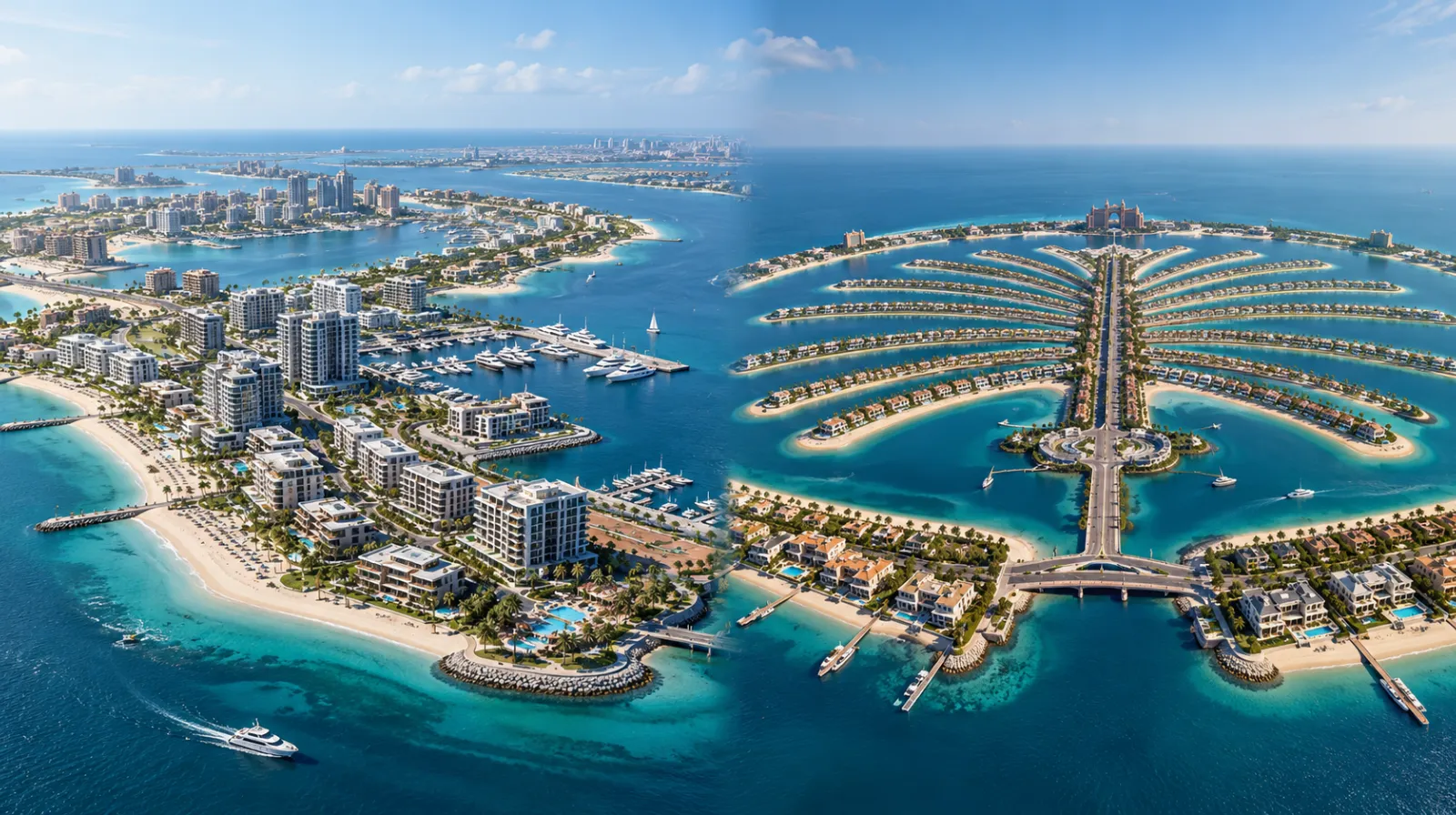
Dubai Islands vs Palm Jebel Ali investment is not a universal winner-takes-all decision; Dubai Islands may fit buyers who want earlier urban integration and a broader possible unit mix, while Palm Jebel Ali may fit higher-budget buyers who prefer villa-led waterfront exposure and a longer holding period, so the better choice depends on your budget, property type, hold period, rental timeline, and risk tolerance—but which of those filters should carry the most weight for your case?
Key Takeaways
If you are making a first-pass comparison, the practical goal is not to crown a winner. It is to separate what is officially verifiable from what still needs seller-side confirmation, especially for Dubai Islands property prices, payment plans, and handover timing.
| Factor | Dubai Islands | Palm Jebel Ali |
| Location | Dubai island-community context is publicly referenced as part of Dubai's broader island destination landscape | Waterfront island destination in Dubai; buyers should verify exact subproject location and access details through current official materials |
| Master developer | Verify current official developer materials | Verify current official developer materials |
| Development stage | Varies by subproject; verify current official developer materials | Varies by subproject; verify current official developer materials |
| Property mix | Often discussed as potentially broader than a villa-only market, but verify current live inventory by project | Often discussed as villa-led or plot-led, but verify current live inventory by project |
| Current entry price | Verify current official developer materials and date any quote before comparing | Verify current official developer materials and date any quote before comparing |
| Payment plans | Verify current official developer materials | Verify current official developer materials |
| Handover horizon | Verify current official developer materials | Verify current official developer materials |
| Connectivity | Practical appeal may come from being part of Dubai's wider coastal and urban network; verify road access by project | Practical appeal may depend more heavily on future infrastructure and exact road access; verify by project |
| Rental readiness | Depends on whether the specific unit is completed, near-complete, or off-plan | Depends heavily on actual completion status and end-user handover timing |
| Capital-growth thesis | Possible thesis: earlier integration and broader buyer pool. This is interpretation, not certainty | Possible thesis: lower-density luxury waterfront scarcity. This is interpretation, not certainty |
| Key risk | Premium pricing before the full area experience is operational | Longer visibility horizon and narrower buyer pool at higher budgets |
Date note: all project-specific pricing, plans, and handover details should be checked against current official developer materials at the time of inquiry.
Dubai Islands property investment is easier to understand if you view it as a waterfront district thesis rather than a single-project thesis. The island-community framing is publicly visible in Dubai's official tourism context, which supports the broader lifestyle logic of a coastal destination within the city fabric, but it does not verify project-level investment data such as unit count, launch stock, pricing, or handover dates.
From an investor's point of view, Dubai Islands may appeal to buyers who want more than one possible use case. That can include a future end-user move, a rental strategy once stock is delivered, or a resale strategy based on wider buyer appeal. The practical attraction is not just waterfront positioning. It is the possibility of combining island living with easier day-to-day city integration, assuming the specific subproject supports that in reality.
A cautious way to evaluate Dubai Islands is to break it into three layers:
Likely buyer and tenant profile is an interpretation rather than an official fact. In practice, Dubai Islands may attract buyers who want waterfront branding without limiting themselves only to ultra-high-ticket villa stock. That does not mean every subproject will be liquid or rent-ready sooner. It means the possible audience may be broader if the inventory mix includes more accessible unit types.
Palm Jebel Ali property investment should be approached as a long-horizon waterfront allocation, not as a short-term income assumption. Without official developer pages in the approved source pack, the safest comparison is conceptual: many buyers look at Palm Jebel Ali for larger-format luxury exposure, stronger privacy appeal, and the scarcity logic that can come from a highly branded island setting.
That said, the most important data points still need project-level verification before a buying decision. Those include exact product mix, current launch availability, handover sequencing, infrastructure timing, and payment schedule. In other words, it may be reasonable to treat Palm Jebel Ali as a higher-budget, longer-duration profile, but not reasonable to assume every release within it carries the same risk or upside.
For many investors, Palm Jebel Ali becomes more compelling when the goal is one of these:
The trade-off is usually straightforward. Higher ticket sizes can mean a narrower resale audience, and a narrower resale audience can mean lower liquidity even when long-term buyer interest is strong.
The right way to compare Dubai Islands vs Palm Jebel Ali on price is to compare like for like. Do not compare an apartment launch in one location with a beachfront villa in another and call that a meaningful price gap. If official developer pricing is not available in your file set, the better method is to compare price per square foot, total ticket size, installment structure, and the amount due before handover using dated quotes from current official materials.
| Comparison item | How to assess Dubai Islands | How to assess Palm Jebel Ali |
| Property type baseline | Compare apartment to apartment, townhouse to townhouse, and villa to villa | Apply the same rule: compare only matched property types |
| Price per sq ft | Use a current, dated official quote | Use a current, dated official quote |
| Total ticket size | Check the all-in purchase amount, not just the headline rate | Check the all-in purchase amount, not just the headline rate |
| Payment schedule | Verify the booking amount, construction-linked installments, and final payment | Verify the booking amount, construction-linked installments, and final payment |
| Historical launch prices | Keep separate from today’s live inventory | Keep separate from today’s live inventory |
| Discount claims | Confirm directly in current official materials | Confirm directly in current official materials |
As of the drafting date of this article, exact project pricing and payment plan details are best treated as verification items unless you are reviewing current official developer material for a specific subproject. That is especially important when comparing Nakheel island developments Dubai because launch headlines can quickly become outdated.
Rental income timing is not the same thing as launch momentum. A project can attract strong buyer attention while still being far from stabilized rental performance. For that reason, Dubai Islands vs Palm Jebel Ali investment should be filtered through one practical question: when can this specific unit realistically start producing income, if income is your priority?
Projected rent means a forward-looking estimate. Achieved rent means the rent actually being paid in completed, occupied stock. Those are not the same. For off-plan property, your real timeline depends on delivery, snagging, furnishing if relevant, market absorption, and the quality of surrounding amenities when handover happens.
A practical comparison checklist:
Rental returns are not guaranteed. If your priority is earlier income visibility, focus less on branding and more on actual completion status, unit type, service-cost burden, and the depth of the likely tenant pool.
Capital appreciation and resale liquidity are related, but they are not the same thing. Appreciation is the change in value over time. Liquidity is how easily you can find a buyer at a workable price when you want to exit. A waterfront asset can have a strong long-term story and still be less liquid in the short term if the buyer pool is narrow.
Both destinations can benefit from the general scarcity appeal of waterfront land. But scarcity only helps if future supply stays disciplined, the surrounding area becomes usable in practice, and the buyer audience remains deep enough for resale activity. This is why the strongest comparison is not just island versus island. It is broad-buyer product versus niche-buyer product.
Key drivers to compare:
The balanced view is simple: Dubai Islands may offer a broader eventual resale audience in some product categories, while Palm Jebel Ali may appeal more strongly to a narrower luxury segment. Neither outcome is automatic, and neither guarantees stronger appreciation.
Lifestyle matters because end-user demand often shapes rental demand and resale demand. Dubai's official island-community content supports the broader idea that island living is a recognized part of the city's lifestyle landscape, but practical usability still has to be checked at the project level.
Dubai Islands may suit buyers who value being closer to established city patterns, hospitality options, and a waterfront experience that can potentially connect more easily with everyday urban use. Palm Jebel Ali may suit buyers who care more about space, privacy, and a retreat-style waterfront identity, even if that means a longer wait for the full area ecosystem to mature.
| Lifestyle factor | Dubai Islands | Palm Jebel Ali |
| Beach and waterfront access | Core part of the destination logic; verify project-specific access | Core part of the destination logic; verify project-specific access |
| City-center practicality | May appeal to buyers who want stronger day-to-day city integration | May appeal more to buyers prioritizing destination living over centrality |
| Airport/business access | Verify route practicality by exact subproject | Verify route practicality by exact subproject |
| Schools and family use | Check nearby existing options, not just planned amenities | Check nearby existing options, not just planned amenities |
| Retail and hospitality | Distinguish operational offerings from future plans | Distinguish operational offerings from future plans |
| End-user profile | May suit mixed-use lifestyle buyers | May suit privacy-led luxury end-users |
A good rule here is to separate brochure lifestyle from usable lifestyle. If the property is partly an end-user decision, test the area as if you or your future tenant would actually live there week to week.
A useful comparison should make the trade-offs visible. Waterfront master developments can be compelling, but they also come with timing and execution variables that matter more than a launch headline.
Educational content; verify current rules with official sources.
The most practical answer is profile-based. Instead of asking which destination is better in the abstract, ask which one may fit your capital size, hold period, and intended use more cleanly.
| Investor profile | May fit better | Why |
| Lower-entry apartment investor | Dubai Islands may be worth considering | If current official inventory includes more apartment options, the entry path and buyer pool may be broader. Verify live stock first. |
| Luxury villa buyer | Palm Jebel Ali may fit better | Buyers focused on large-format private waterfront living may prefer a villa-led comparison set. |
| Rental-income investor | Case by case | The better fit depends on delivered stock, rent-ready timing, service charges, and tenant depth, not branding alone. |
| Long-term capital-growth buyer | Either may fit | Dubai Islands may suit buyers who want earlier area visibility, while Palm Jebel Ali may suit buyers comfortable with a longer luxury-led hold. |
| End-user | Depends on lifestyle priorities | Buyers who want more urban integration may lean one way, while buyers seeking greater privacy and space may lean the other. |
Use this table as a filter, not a final verdict. Once your profile is clear, the next step is to compare actual units rather than area narratives.
This section is most useful when it stays transparent about what has been verified and what has not. Because the approved source pack does not currently include official developer project pages for both destinations, it is safer not to publish specific project names, prices, or payment terms until they can be confirmed through current official sources.
For any Dubai Islands or Palm Jebel Ali project being considered, compare:
For a real buying decision, these details should be checked against the developer’s current official inventory and, where available, Dubai Land Department project information immediately before reservation. Prices, available units, payment schedules and project status can change over time.
That depends on the actual inventory available when you are buying. If one destination offers more apartment stock and the other is more weighted toward villas or larger homes, the lower-entry option may differ sharply by project. Verify current official pricing and unit type before comparing.
The better rental-income fit depends on when the unit can start operating, what type of tenant it targets, and what the ongoing service-cost burden looks like. A broader tenant pool can matter more than brand prestige if your goal is steadier occupancy.
Some opportunities may be off-plan, but buyers should verify the exact status of each subproject and each unit. In large master developments, launch stage and completion stage can vary meaningfully.
Residency is not automatic, and it is different from citizenship. A long-term residency route for real estate investors may apply from a minimum total property value of AED 2,000,000 under the published threshold, including qualifying off-plan property purchased from an approved local real estate company. Dubai also offers a residence permit service for property owners. Approval depends on current official criteria and the buyer's case.
The referenced sale registration page lists that the buyer pays 2% of the sale value and the seller pays 2% of the sale value, and it also provides the registration process, required documents, and payment methods. Buyers should still verify the full current fee schedule for their transaction type before signing.
That may be a useful first comparison lens, but it should not be treated as a rule. Product mix can change by release, and your decision should be based on active inventory rather than area reputation alone.
Neither is inherently lower risk for every buyer. Risk depends on development stage, ticket size, exit flexibility, income timing, and how long you can hold if market conditions change.
Use a structured checklist: verify current official price, payment plan, completion status, handover horizon, service-cost structure if available, actual unit type, resale conditions if any, and whether the property fits your real goal of income, long-term growth, or end use.
There is no single winner in Dubai Islands vs Palm Jebel Ali investment. Dubai Islands may look stronger for buyers who want earlier visibility, potentially broader inventory choice, and a more mixed-use urban-coastal profile, while Palm Jebel Ali may be worth stronger consideration for higher-budget buyers who are comfortable with a longer luxury-led hold and a narrower but more specialized buyer audience.
If you want a clearer decision, ask for a side-by-side unit comparison based on your budget, intended hold period, and target outcome. That kind of structured comparison usually leads to a more transparent, more defensible property decision than choosing based on branding alone.
Latest Blogs
Oct 14, 2026
Oct 12, 2026
Sep 30, 2026

Sep 28, 2026