
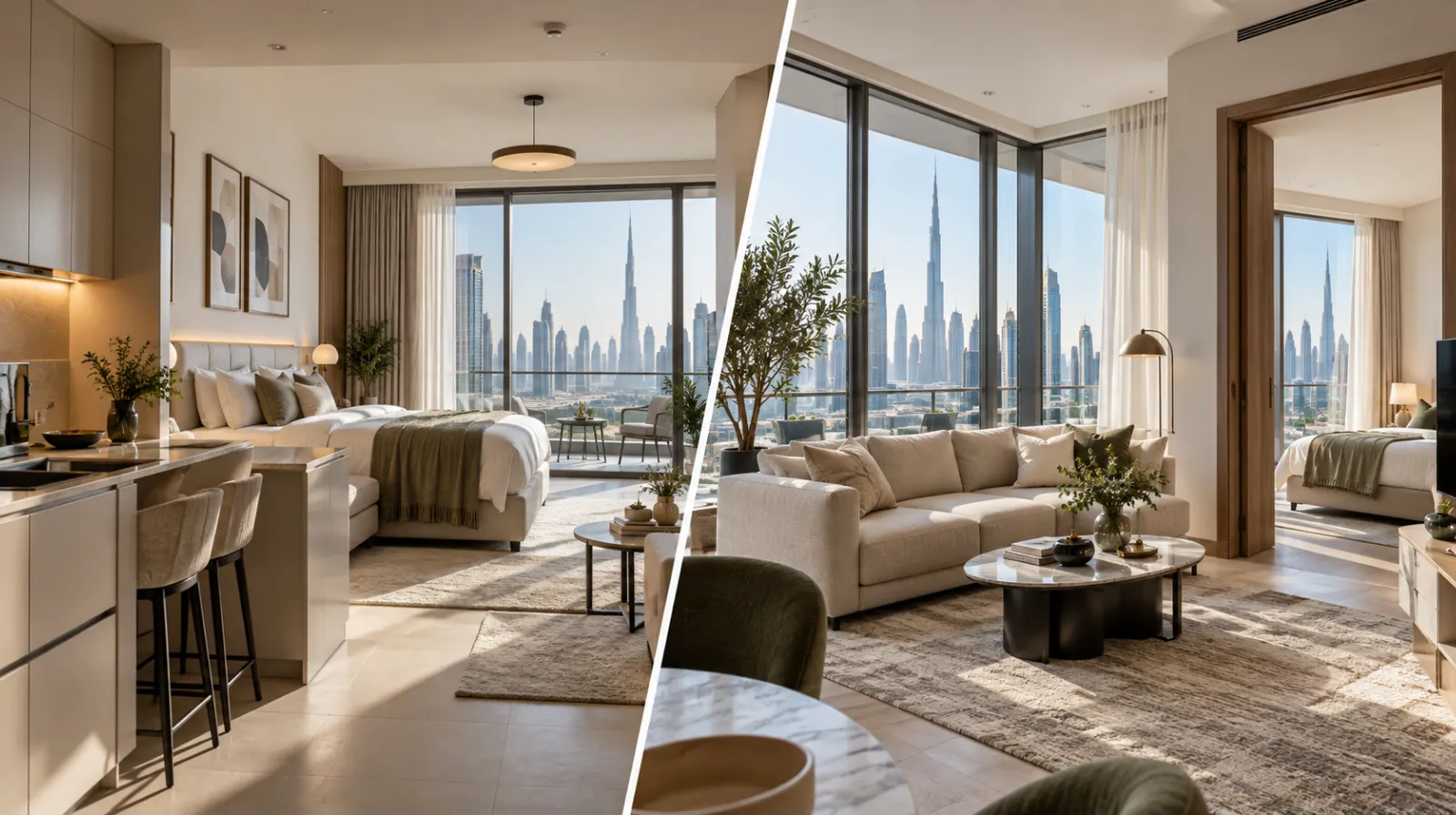
Studio vs 1-Bedroom Apartment Dubai Investment Guide
Oct 14, 2026

Blog Detail
Industry operators and property market data point to a more mature market, where quality, licensing and guest experience are increasingly determining performance
Article
A rise in Gen Z travellers, longer stays from European visitors, and rising price sensitivity are reshaping Dubai’s short-term rental (STR) market as the sector heads into 2026. Data also shows that prices and occupancy are holding firm despite global economic uncertainty.
Industry operators and property market data point to a more mature market, where quality, licensing, and guest experience are increasingly determining performance amid intensifying competition and growing supply.
Property Finder data indicates that Dubai’s short-term rental market continues to show resilience. According to the platform, STR supply increased by 3 percent year-on-year, while seasonal demand remains a defining feature of the sector.
“Demand during the winter months is typically two-and-a-half to three times higher than in summer,” said Cherif Sleiman, Chief Revenue Officer at Property Finder, noting that seasonality also continues to shape pricing.
In November 2025, the median daily asking price for short-term rentals stood at Dh780, compared with Dh670 during the same period last year. Weekly asking prices rose to Dh5,000, up from Dh4,500 year-on-year, while monthly rates remained stable at Dh16,000.
Sleiman said November data showed asking prices, “trending slightly higher compared to the same period last year,” particularly for daily and weekly rentals, where market activity remains strongest.
Alongside pricing resilience, operators say guest demographics and booking behavior are shifting. Anna Skigin, founder and CEO of Frank Porter, said the company recorded a 25 percent year-on-year increase in Gen Z travelers in 2025, a trend expected to accelerate in 2026.
These travelers love to document their stays on social media and prefer properties with a bit of character or interesting views and amenities,” Skigin said. “They prioritize trips that look good on their socials.”
Frank Porter has also seen European travellers extending their stays, with average booking lengths rising to almost 10 days, up from the previous year. At the same time, guests are becoming increasingly deal-conscious.
We are seeing guests book more stays that have some sort of ‘deal’ or discount,” Skigin said, adding that Gen Z travellers in particular tend to be more price sensitive and motivated by value.
Despite an influx of new units and operators, Skigin said rising competition has not translated into weaker performance across the board. Instead, she pointed to a more disciplined market environment.
Major platforms have been focusing on quality over quantity and have removed many ‘bad players’ from the platform,” she said, adding that initiatives by Dubai’s Department of Economy and Tourism to ensure only licensed properties are available have also helped remove illegal operators.
As a result, the market is now “more mature,” with quality increasingly driving both occupancy and pricing. “Prices and occupancy are higher in 2025 versus 2024,” Skigin noted.
While established areas such as Business Bay, Dubai Marina, and Jumeirah Village Circle continue to attract strong demand, Property Finder data also shows growing interest in emerging districts.
Sleiman pointed to Meydan as an area gaining traction due to competitive pricing, improved road connectivity, and an expanding range of amenities, including retail, dining, and healthcare.
From an operator’s perspective, Skigin said demand growth is often tied to new developments rather than legacy neighborhoods. “As new areas come together and there is more to do, there is more demand for nearby accommodation,” she said, citing JVC as a long-term example of how an area’s performance can evolve.
However, she added that across all locations, “what really drives demand and price is the property itself—how it looks, the furnishings, views, and any extra amenities.
Looking ahead, global regulatory tightening remains a backdrop for the sector, with markets such as Spain introducing stricter licensing and oversight for short-term rentals. Skigin said regulation in itself is not a concern, provided it supports quality and transparency.
As long as regulations are fair and honest, there is no risk,” she said, adding that controls that ensure quality for tourists benefit both guests and compliant operators.
Dubai, she noted, already offers a stable regulatory environment with clear licensing requirements, which industry players say has helped professionalize the market.
Into 2026, operators expect pricing resilience to continue alongside evolving traveler expectations, with quality, value, and experience shaping how Dubai’s short-term rental market competes on the global stage.
Latest Blogs
Oct 14, 2026

Oct 12, 2026

Oct 10, 2026

Sep 30, 2026

Sep 28, 2026