Homeland Logo

Minimum Salary Required to Buy Property in Dubai

Minimum Salary Required to Buy Property in Dubai
Share:

Jan 16, 2026

Owning property in Dubai’s dynamic real estate market is an achievable goal for many, but it requires careful financial planning. A key factor is your income – specifically, what minimum salary you need to comfortably purchase a home in Dubai. This involves understanding mortgage requirements, upfront costs, and the relationship between your earnings and the property you can afford. In this guide, we’ll break down the latest information (as of 2025) on salary requirements for buying property in Dubai, ensuring the details are informative, up-to-date, and easy to understand.


Dubai’s Property Market and Why Income Matters

Dubai’s property market has been booming, attracting both residents and foreign investors. In 2024, real estate transactions exceeded AED 760 billion, reflecting strong demand. Incentives like long-term Golden Visas for property owners, the availability of freehold zones for foreigners, and flexible payment plans from developers have made buying in Dubai more accessible. High rental yields (often 6–8% annually) further entice buyers and investors. Moreover, there are no annual property taxes on homes in Dubai, which enhances the appeal of owning real estate in the emirate.

Despite this attractive environment, purchasing property is a significant financial commitment. Unless you buy entirely in cash, you’ll likely need a home loan (mortgage) – and banks will look closely at your income to decide if you qualify. Thus, knowing the minimum salary required isn’t about a legal rule as much as it is about meeting bank criteria for a mortgage and ensuring you can afford ongoing costs. Let’s explore what salary level you need and why.


Mortgage Eligibility and Minimum Income Requirements

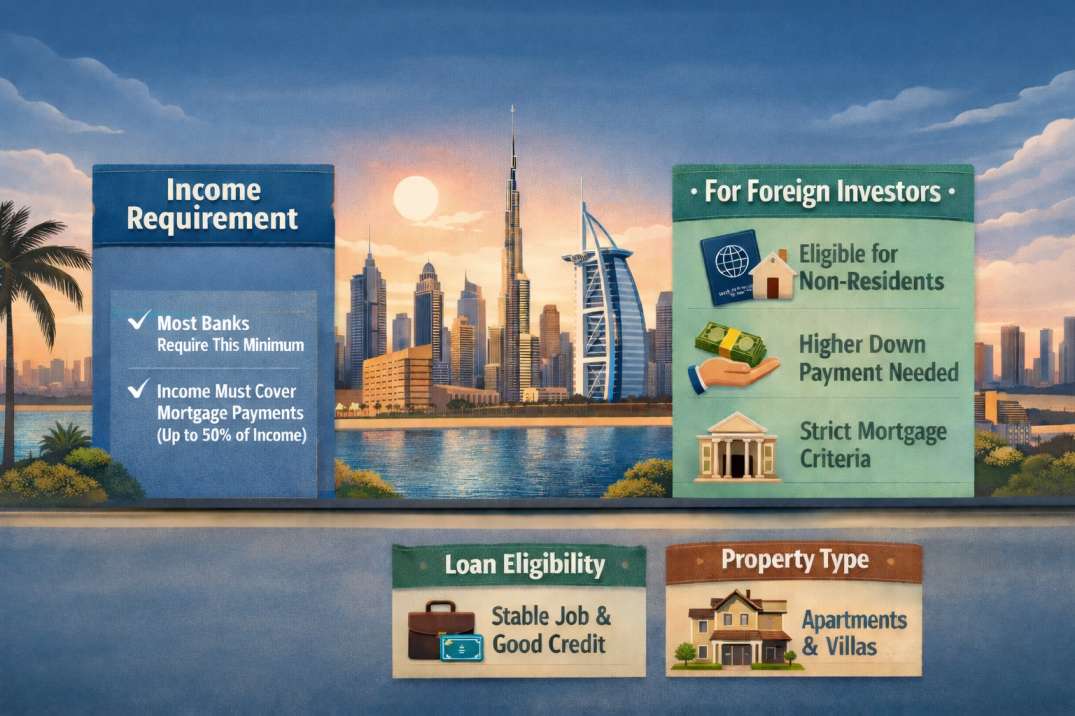
If you plan to finance your property through a mortgage, your salary will be one of the first things lenders evaluate. While Dubai has no government-imposed minimum salary to buy property, banks set their own criteria for loan approval. In fact, the UAE Central Bank removed its previous blanket minimum salary rule for personal loans in 2025, allowing banks to determine thresholds based on their internal policies. In practice, most banks in the UAE require a minimum monthly income of around AED 15,000 to consider you for a home loan. This figure is a common benchmark for both UAE residents and expatriates seeking mortgages.


Exceptions: A few banks may offer limited mortgage options to expatriates earning as little as AED 10,000 per month (and to Emirati nationals at about AED 8,000), but these are not the norm. The majority of lenders stick to the ~AED 15k income mark as a baseline for mortgage approval. Essentially, ≈AED 15,000/month is viewed as the realistic minimum salary for buying a home with financing in Dubai’s current market. Below that level, financing options become very restricted and the choice of properties affordable under those loans narrows significantly.


Debt Burden Rule: Even if you meet the income threshold, banks will ensure the monthly mortgage payments are manageable relative to your earnings. Typically, mortgage repayments are capped at 50% of your monthly income by UAE banks. In other words, your total debt obligations (including the new mortgage and any existing loans or credit card debt) shouldn’t exceed half of what you earn each month. Some lenders may use more conservative formulas – for instance, one source notes many banks prefer the mortgage EMI (equated monthly installment) not to exceed about 25%–30% of monthly income for comfort, even though 50% is the legal upper limit. This is to ensure you have enough income left for living expenses and unforeseen costs. Banks also typically count only a portion (e.g. 50%) of any variable income like bonuses or commissions to assess your repayment capacity.


Other Eligibility Factors: Importantly, salary alone isn’t the only criteria. Lenders will also evaluate your employment stability, employer profile, existing debts, and credit history before granting a mortgage. They want to see that you have a stable job (and ideally have been with your employer for a certain period), that your employer is reputable, and that you don’t have heavy debt elsewhere or a record of payment issues. In many cases, banks require borrowers to take out a mortgage life insurance policy as well, which covers the loan in case of death. All these factors together determine how much you can borrow and on what terms.


What if you’re below the usual salary cutoff? If your income is under the common AED 15k threshold, it becomes challenging to get a sizable home loan. You might still find a bank willing to lend (especially for UAE nationals or certain professionals), but expect stricter conditions – such as a lower loan amount, higher interest, or a requirement for a larger down payment. Another approach for lower-income buyers is to consider joint applications (e.g. spouses combining incomes) or to focus on smaller, more affordable properties first (we’ll cover affordable property options by salary range later).

Lastly, remember that if you buy without a mortgage (cash purchase), there is technically no minimum salary required at all – since no bank is involved in the transaction. In cash deals, no one will verify your income. However, you then need the full property price in savings, and the onus is on you to budget wisely for all costs. Cash buyers often enjoy faster transactions and more negotiating power, but for most people, mortgages make property buying feasible, which is why understanding income requirements is crucial.


Down Payments and Upfront Costs in Dubai

Whether you are a UAE resident or a foreign investor, buying property in Dubai means coming up with a substantial down payment and covering certain purchase fees. These upfront costs directly affect how much money you need on hand (savings), which ties into how high a salary you’d realistically need to accumulate those savings.


Down Payment: For a first-time home buyer in Dubai, the minimum down payment is 20% of the property price for expats, and slightly lower at 15% for UAE nationals, under current Central Bank regulations. This is the minimum required if the property value is up to AED 5 million. (For any amount above AED 5M or for second homes, the required down payment percentage is higher – typically 30% or more for expats.) Banks may ask for a larger down payment depending on your financial profile, but you should plan on at least 15–20% upfront as a starting point.


One-Time Purchase Fees: In addition to the down payment, budget about 7–8% of the property value for various fees and taxes that come with buying a home. The major costs include:


  • Dubai Land Department (DLD) fee: 4% of the property price (this is a transfer tax) plus a small fixed admin fee (around AED 580).

  • Registration trustee fee: Approximately AED 2,000 for properties under AED 500k, or AED 4,000 for properties above AED 500k, plus 5% VAT on that fee.

  • Mortgage registration fee: 0.25% of the loan amount (if you’re taking a mortgage) + AED 290 admin fee.

  • Valuation fee: Around AED 2,500–3,500 (charged by the bank to valuate the property).

  • Real estate agent’s commission: Typically 2% of the purchase price, plus 5% VAT on the commission.

  • Miscellaneous: Minor admin fees for title deed issuance (about AED 520) and some developers charge their own admin fees for processing the sale.

These fees add up. In total, buyers should expect upfront transaction costs roughly in the range of 6%–8% of the property value, on top of the down payment. For example, if you’re buying a property worth AED 1,000,000, aside from the AED 200,000 down payment (if expat), the extra fees could be around AED 60,000–80,000. It’s crucial to have this amount saved so that you’re not caught off guard during the purchase process.


  • Why These Matter for Salary: The need for a down payment and fees means you must accumulate a significant amount of savings. A higher salary obviously makes it easier to save up 20%+ of a property’s price. If your income is just enough to qualify for a mortgage (say around AED 15k/month), you’ll likely need a couple of years of disciplined savings to build the down payment and fee fund. Banks will not finance these upfront costs; they come out of your pocket. Some developers do offer post-handover payment plans or allow a series of installments for the purchase price (reducing the immediate down payment burden), but you’ll still need to demonstrate financial capacity to meet those installments on schedule.

How Much Should You Earn to Afford a Property? (Salary Brackets vs Property Types)


The salary you earn will influence what price range of property you can comfortably afford (with a mortgage). Industry experts in Dubai often break this down by income brackets, giving a rough idea of the property size/type that each income level can support under typical lending conditions. Keep in mind these are generalized guides, assuming you have minimal other debts and at least the minimum down payment:


  • Monthly Salary ~AED 15,000–20,000: This is around the entry-level for property buying. With this income, you would be looking at smaller units in affordable communities as a first purchase. For example, a studio or a modest one-bedroom apartment in areas on the outskirts or upcoming developments can fall in this range. At AED 15k/month, you’re likely eligible for a loan that can finance a studio in districts like Dubai South, International City, Town Square, Arjan, or Dubai Silicon Oasis, which are known for value-for-money housing. Experts say roughly a studio apartment requires ~AED 15k+ income, and a one-bedroom might require closer to AED 20k+ to be safe. If you earn towards the lower end (15k), you’ll need to be very selective and probably opt for the smallest units available or consider properties far from the city center to stay within budget. In this bracket, banks will likely only approve a loan that keeps your monthly installment at or below ~7k (which is 45-50% of 15k), translating to a relatively modest loan amount.

  • Monthly Salary ~AED 20,000–30,000: In this range, your home choices broaden to standard one-bedroom or two-bedroom apartments in mid-tier communities. Earning around AED 25k a month, for instance, could make it feasible to buy a decent one-bedroom in a popular expatriate area like Jumeirah Village Circle (JVC), Jumeirah Lake Towers, or Al Furjan, especially if you have a good down payment. According to market guides, a one-bedroom apartment typically becomes affordable once you’re earning in the low-to-mid 20-thousands per month. With AED 30k/month, you might even consider a small townhouse or larger apartment in an emerging community. Financial planners advise that in the AED 20k–25k income bracket, one should remain prudent – focus on affordable communities and moderate unit sizes, rather than stretching to luxury neighborhoods too soon. This ensures you don’t over-leverage yourself. Off-plan properties with developer payment schemes can be attractive in this range, as they sometimes allow you to pay gradually and possibly after handover, making the purchase more manageable, but always evaluate the developer’s reputation and the additional costs like service charges.

  • Monthly Salary ~AED 35,000–50,000: At this income level, you have a lot more flexibility. A salary in the high-30s or 40k range means you can comfortably afford larger apartments (2-3 bedrooms) or properties in prime locations with the help of a mortgage. With, say, AED 40k per month, banks would potentially allow monthly payments up to ~20k (50%), which could fund a loan for a high-end apartment or even a mid-range villa, assuming you have the down payment ready. Real estate advisors note that incomes in the 35k+ range let buyers choose in a wider variety of neighborhoods and property types, including established central areas like Dubai Marina or Downtown (if closer to 45k/month). In fact, to buy comfortably in prime areas such as those, an income of roughly AED 35,000–45,000 per month is often cited as necessary, given the higher property prices and ongoing costs in those districts. So, mid-to-high five-figure earners can look at desirable locations and bigger homes without stretching too thin, particularly if they also have substantial savings to put down.

  • Monthly Salary ~AED 50,000 and above: Once you cross into a higher income bracket (50k, 60k, and up), you are in a good position to purchase luxury properties or spacious villas. Typically, villas or townhouses (especially in prime or well-developed communities) require about AED 45k–60k+ monthly income to be attainable with financing. For example, an upscale four-bedroom villa in a sought-after neighborhood might only be financeable if you have this level of income or higher, because the loan needed would be large and banks will require both a big down payment and confidence in your repayment ability. Buyers in this salary range can also more easily handle the higher running costs (maintenance, utility bills for larger homes, etc.). It’s worth noting that even high earners must still comply with the same 20% (expat) down payment rule; so on a multi-million-dirham property, the cash required upfront is substantial. Many high-income individuals choose to invest in multiple properties, taking advantage of Dubai’s no-tax regime on property income and capital gains – but each purchase will still be judged by the bank on its own merits and the buyer’s debt burden.

In summary, the minimum salary to buy property in Dubai with a mortgage is roughly AED 15k per month, but that would limit you to smaller units in budget areas. Earning more (say AED 20–30k) gives you a comfortable range of choices in the mid-market segment. And with very high salaries (AED 35k, 50k, or more), you can explore premium real estate or larger family homes. These figures assume you also have the requisite down payment and that you keep other debts low. It’s also assumed you’re a resident earning your income in the UAE; we will discuss foreign investors in the next section.


UAE Nationals vs. Expatriates: Does the Required Salary Differ?

Broadly speaking, the salary requirement for a mortgage applies similarly to both UAE citizens and expat residents – banks want to see sufficient, stable income either way. However, there are a couple of differences in regulations and options that are worth noting:


  • Lower Down Payment for Nationals: As mentioned earlier, Emirati buyers enjoy a lower minimum down payment (15%) for their first property, compared to 20% for non-nationals. This means UAE nationals can borrow slightly more against the property value. In practical terms, a UAE citizen with a given salary might afford a somewhat pricier property than an expat with an identical salary, because the citizen needs to put down less cash and can take a larger loan (up to 85% LTV, versus 80% for expats).

  • Bank Income Criteria: Some banks have tailored products or considerations for UAE nationals working in government or certain sectors, occasionally allowing mortgages with incomes under the usual threshold. It’s reported that a few banks may approve Emirati applicants with salaries around AED 8,000–10,000 (if other conditions are very strong), whereas expat applicants generally need at least five figures monthly. That said, most banks still align around the ~15k figure regardless of nationality for standard home loans. The removal of the central bank’s 5k rule means theoretically a bank could set a lower minimum for citizens, but in the realm of home financing, the risk and loan sizes mean both locals and expats are held to high income standards for property purchase.

  • Special Programs: The government and banks sometimes launch schemes to help UAE nationals, such as housing programs or preferential rates, which might indirectly lower the income barrier (for example, by subsidizing part of the loan or offering longer tenure). For expats, developer rent-to-own or long-term payment plans can ease the salary requirement somewhat, since these alternatives might not require immediate bank financing. However, those are specific cases. Generally, count on needing similar income levels whether you are an expatriate or a local, with the main difference being how much you need to pay upfront and the availability of certain low-income lending options for citizens.

Can Foreign Investors Buy Property with a Low Salary?

What if you are a foreign investor who isn’t employed in the UAE – can you still buy property, and does “minimum salary” apply to you? The good news is Dubai’s property market is very open to foreign buyers. Thanks to the 2002 Freehold law, foreign nationals (non-residents) can purchase and fully own property in Dubai’s designated freehold areas without needing any local sponsor or residency status. Popular freehold areas include places like Downtown Dubai, Dubai Marina, Palm Jumeirah, JVC, and many more, and foreign buyers have the same property ownership rights as anyone else in those zones.


However, the concept of “required salary” is mostly relevant if you need a mortgage from a UAE bank. If you are a non-resident investor (for example, living in your home country but buying an apartment in Dubai as an investment), you likely won’t have a UAE salary. Some UAE banks do offer mortgages to non-resident foreigners, but they will still look at your income in your home country or overall net worth. These loans often come with stricter terms – e.g. a bigger down payment (often 50% or more), lower loan-to-value, and higher interest rates, since lending to a non-resident is riskier for the bank. Practically speaking, many foreign investors simply buy property in cash or with minimal financing from outside the UAE. If you’re purchasing as an overseas investor and paying cash, then your salary is not scrutinized at all; what matters is that you have the funds available.

For foreign investors who are residing and working in the UAE (expatriate residents), the same salary rules we discussed earlier apply – you’ll need roughly AED 15k monthly income to access most mortgages, and more for higher-end purchases. The banks don’t differentiate whether you intend to live in the property or rent it out; it’s purely about your ability to repay the loan.


It’s also worth noting that buying property in Dubai can be a route to UAE residency visas. Currently, investing AED 2 million or more in property can make you eligible for a renewable long-term Golden Visa, and a smaller investment of AED 750k can grant a 2-year residency for investors. While this is separate from salary requirements, it’s a consideration for foreign buyers — if you have the means to invest at those levels (which typically implies a high income or substantial savings), you gain residency benefits. But even with a Golden Visa, if you need a mortgage, the bank will still require proof of income and ability to pay.


Bottom line: Foreigners are welcome to buy in Dubai. If you won’t be taking a local loan, there’s no formal salary requirement to purchase. If you will seek financing, then ensure your income (whether local or overseas) would meet the equivalent of UAE banks’ standards, or be prepared to offer a larger down payment to offset a lower income. Many foreign investors partner with mortgage brokers or use financing from their home country to facilitate Dubai purchases if their UAE income isn’t high enough.


Additional Financial Considerations for Buyers

Beyond the salary and upfront payments, there are other financial factors to keep in mind when preparing to buy property in Dubai:


  • Ongoing Home Ownership Costs: Don’t overlook the recurring expenses that come after you’ve bought the property. These include service charges (association or maintenance fees for apartments, charged per square foot annually), home insurance, utilities, and general maintenance or repairs. For example, service charges in Dubai can range roughly from AED 10 to AED 30 per square foot per year for apartments, depending on the development’s facilities. Villas often have lower service charge rates (since they lack shared facilities), but owners then bear higher direct maintenance costs (garden, pool, exterior upkeep, etc.). Make sure your monthly budget (post-purchase) accounts for these costs along with the mortgage payment. As one mortgage advisor noted, many first-time buyers fixate on saving for the down payment and EMI, but forget expenses like maintenance, utility deposits, moving costs, and furnishings, which can add up quickly. A prudent approach is to set aside a contingency fund for property maintenance and other surprises, so that these outlays don’t jeopardize your ability to pay the mortgage.

  • Interest Rates and Loan Terms: Keep an eye on mortgage interest rates, as they directly affect how much you pay each month and therefore what salary is needed. In 2025, typical home loan rates in the UAE ranged around 4–5% per annum. If rates rise, loans become costlier (higher EMI), meaning you’d need a bit more income to afford the same property. Conversely, lower rates improve affordability. Most mortgages in Dubai are offered for tenures up to 25 years. Opting for a longer tenure can reduce the monthly installment – useful if you are near the edge of the income requirement – though it means paying more interest over time. Always use a mortgage calculator to plug in your salary, prospective loan amount, interest rate, and tenure to gauge the affordability; many bank and real estate websites provide such tools.

  • Market Conditions and Prices: Property prices in Dubai can fluctuate with market conditions. During a market upswing, prices rise, and the same salary might afford a bit less in terms of property size or location than it did a few years prior. Indeed, experts have observed that “a salary of Dh20,000 today generally buys less space or a less central location than it did five years ago” due to price increases. Being aware of market trends can help set realistic expectations. On the bright side, developers and the government have introduced measures like first-time buyer incentives, reduced fees, and flexible payment plans to keep home ownership within reach despite higher prices. For instance, some new schemes give discounts on off-plan properties or preferential interest rates for eligible buyers. Stay informed on such initiatives, as they can effectively lower the salary barrier by reducing the cost burden.

  • Overall Financial Planning: Buying a property shouldn’t be done in isolation from your other financial goals. Ensure you are not compromising your emergency savings, retirement plans, or incurring unmanageable debt. It might help to consult a financial advisor or mortgage broker who can look at your complete financial picture. They can advise if you should perhaps pay off existing loans or credit cards before taking on a mortgage (since banks consider your debt-to-income ratio comprehensively). Also, consider the stability of your income – if your job or industry is volatile, it might be wise to have a bigger financial cushion or a smaller loan. Remember, losing a job while having a large mortgage can be very stressful, so plan for resilience (for example, having at least 3-6 months’ worth of mortgage payments saved as a buffer).

  • Related Financial Obligations: If you’re moving to or investing in Dubai, you might also engage in other financial or business activities alongside buying property. For instance, some people set up a company (perhaps to manage real estate investments or for other business ventures). In such cases, you’ll encounter additional processes like opening business bank accounts or handling taxes for your company. (Note: Dubai levies no income tax on individuals, but it has VAT on goods/services and certain business activities.) Ensure you’re knowledgeable about these aspects as well – for example, understanding How to Register for VAT in the UAE for a New Company if you plan to start a business, so that you remain fully compliant with local laws. While this is separate from the property purchase, it’s part of the broader financial landscape you’ll navigate when making Dubai your base for investment or residence. Being well-informed on all fronts will help you manage your finances holistically.

Conclusion

Buying property in Dubai is a significant financial milestone, and knowing the income required is a critical part of the preparation. In summary, most banks set a minimum salary requirement of around AED 15,000 per month for home loan applicants in Dubai. This is the baseline that opens the door to property ownership, typically allowing you to purchase a starter home in one of the city’s more affordable neighborhoods. Earning above this level broadens your options – for instance, at AED 20k–30k you can comfortably look at mid-range apartments, and with AED 40k+, you can explore villas or prime location properties as well. Alongside income, be prepared with at least 20% of the property price for down payment (15% for locals) and another ~7% for fees and taxes when you buy.


It’s important to approach this process with a realistic mindset. Banks will evaluate not just your salary, but your overall financial health – including job stability and existing debts – to ensure you can manage the mortgage. Take into account the ongoing costs of ownership (maintenance, service fees, etc.) in your budget planning. If your current salary is below the common threshold, consider strategies like choosing a smaller property first, saving up a larger down payment (which reduces the loan needed), or improving your income situation before buying. And if you have a higher income, still exercise prudence; just because the bank qualifies you for a large loan doesn’t mean you should max it out. Often, financial comfort comes from borrowing a bit less than the absolute maximum you can afford, leaving room for other goals and emergencies.

Get In Touch

Latest Blogs

The Psychology Behind Property Buying Decisions in Dubai

The Psychology Behind Property Buying Decisions in Dubai

Feb 27, 2026
Short-Term Rental Property Management Agreements in Dubai

Short-Term Rental Property Management Agreements in Dubai

Feb 26, 2026
UAE Property: Dubai evolving from temporary stepping stone to long-term home for expats

UAE Property: Dubai evolving from temporary stepping stone to long-term home for expats

Feb 25, 2026
Seal Real Estate Registration Trustee in Dubai: Complete Guide for Property Buyers & Investors

Seal Real Estate Registration Trustee in Dubai: Complete Guide for Property Buyers & Investors

Feb 25, 2026
Top-tier international schools drive 35% surge in Dubai villa prices

Top-tier international schools drive 35% surge in Dubai villa prices

Feb 24, 2026

Latest Projects

View All Projects