

When to Buy Property in Dubai: Best Timing Strategy
Jul 21, 2026
Blog Detail
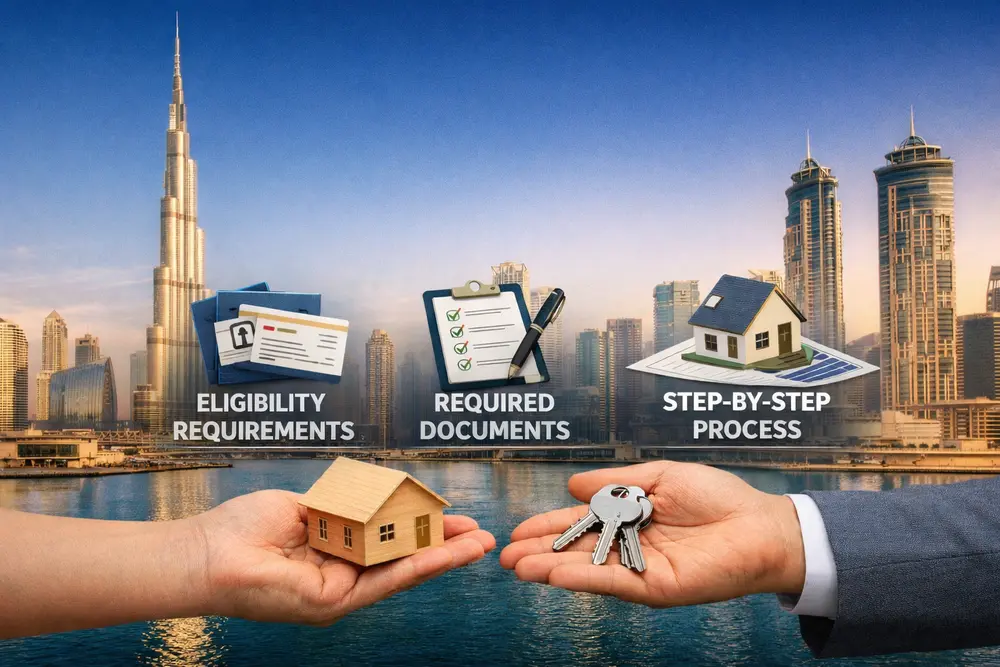
Mortgages in Dubai Eligibility explained with rules, documents, and a clear step-by-step guide for property financing in Dubai.
Article
If you are planning to buy property in the UAE, understanding Mortgages in Dubai Eligibility is the smartest place to start. Dubai’s mortgage market is built on structured regulation: the Central Bank sets nationwide lending guardrails, while Dubai’s land registry rules determine how property rights (and mortgages) become legally effective.
This guide is designed for real estate–interested readers who want a practical, fact-based explanation of how Mortgages in Dubai work, who typically qualifies, and how the process flows from pre-approval to registration—without sales talk, hype, or price-pushing.
A mortgage loan in the UAE is formally defined as a loan secured against residential property, used for purposes such as constructing, purchasing, or renovating a home for owner-occupation or investment. The Central Bank’s 2013 “Regulations Regarding Mortgage Loans” (Circular No. 31/2013) states this definition and also clarifies that mortgages can include loans for the purchase or development of land for these purposes (Central Bank of the UAE website, 2013).
Dubai lending rules (nationwide): The Central Bank’s mortgage regulations aim to set minimum standards for mortgage lending to support consumer protection and financial stability (Central Bank of the UAE website, 2013).
Dubai property registration and mortgage effectiveness (local law): In Dubai, property rights and mortgages rely heavily on registration. Dubai Law No. (7) of 2006 requires that transactions creating, transferring, amending, or extinguishing real property rights be recorded in the Property Register; otherwise, they are not deemed valid (Dubai Legislation Portal, 2006).
Most importantly for mortgages: Dubai Law No. (14) of 2008 states that a mortgage “will come into effect only when it is registered with the DLD,” and any contrary agreement is null and void (Dubai Legislation Portal, 2008).
In practical terms, this is why the mortgage journey in Dubai is not just a bank process—it also includes a formal registration step through the Dubai Land Department (DLD).
“Eligibility” in Dubai is best understood as three overlapping checks: the borrower, the property/right being financed, and the regulatory caps that shape affordability and maximum leverage.
The Central Bank’s mortgage loan regulations highlight that lenders must assess whether the borrower can service the debt responsibly, and they should rely on reliable, sustainable income when making that assessment (Central Bank of the UAE website, 2013).
A key nationwide affordability control is the Debt Burden Ratio (DBR). The Central Bank’s mortgage regulations specify that the maximum DBR allowed is 50% of gross salary and regular income from a defined, specific source (Central Bank of the UAE website, 2013).
The same regulations also require lenders, when calculating DBR, to stress-test the loan by assessing whether repayments remain manageable if interest rates rise by a margin (Central Bank of the UAE website, 2013).
Why this matters for buyers: you can be “eligible” on paper (good job title, deposit saved) and still fail at the DBR stage if you already have significant monthly obligations.
In the UAE, credit information is governed by Federal credit-information legislation and its executive regulation. Cabinet Resolution No. (115) of 2021 defines the credit bureau entity (AECB) and sets out that banks and finance companies are among the parties that may obtain credit information reports/products (UAE Legislation portal, 2021).
The same Cabinet Resolution also makes clear that any person may request a credit information report or credit index on themselves (subject to the Central Bank controls referenced in the Resolution), which is useful before you apply for a mortgage (UAE Legislation portal, 2021).
Historically, age-at-maturity limits were treated as a hard rule. However, the Central Bank announced amendments in October 2019 to lift the prior maximum-age requirement at the time of the last mortgage repayment, stating that the maximum age would be determined by lenders according to their own risk management and lending policies (Central Bank of the UAE press release PDF, 2019).
Separately, the Central Bank’s mortgage loan regulations set a maximum mortgage tenor (term) of 25 years (Central Bank of the UAE website, 2013).
What to take from this: banks have discretion on age policy (within their risk framework), but the regulatory maximum loan term still shapes how the bank
models eligibility and monthly affordability.
In Dubai, your ability to finance is linked to your legal right over the property. Regulation No. (3) of 2006 states that non-UAE nationals may acquire freehold ownership rights (without time restriction) and also other rights such as usufruct or leasehold for up to 99 years, but only in designated areas listed in the regulation (Dubai Legislation Portal, 2006).
This matters because banks typically require a registrable right that can be mortgaged and recorded properly. Dubai’s mortgage law also explicitly covers off-plan situations: it provides that a purchaser of a unit sold off-plan or under construction may mortgage it, provided the unit/property is registered on the Interim Real Property Register maintained by DLD (Dubai Legislation Portal, 2008).
Dubai lenders operate within Central Bank “important ratios” such as LTV (loan-to-value), which is defined as the ratio of the loan outstanding to the appraised value of the residential property (Central Bank of the UAE website, 2013).
The most useful way to understand LTV is as a maximum-financing rule: it effectively sets the minimum equity contribution required from the buyer.
For first-time buyers, the Central Bank increased the LTV ratio by 5% via Board of Directors’ Resolution No. 31/2/2020. In that Resolution, the stated maximum LTVs for first house/owner occupiers reach up to 85% for UAE nationals and up to 80% for expatriates in the relevant value band (CBUAE Rulebook, 2020).
The Central Bank also states that the borrower’s ability to repay should not be assessed based on expected future property price appreciation or expected increases in earning capacity (Central Bank of the UAE website, 2013).
This is worth remembering if you find yourself thinking: “is it a good time to invest in Dubai” When Property Prices Rise in Dubai ? Even if your market view is optimistic, lenders are expected to underwrite affordability based on today’s verified capacity, not tomorrow’s hoped-for gains.
Deposit source and valuation rules buyers often overlook
Source of down payment: The mortgage regulations state that the down payment should be from the borrower’s own resources, not from other borrowing sources such as personal loans or credit cards (Central Bank of the UAE website, 2013).
Independent valuation: Before any irrevocable commitment to lend, an independent on-site valuation must be undertaken by a suitably qualified third party independent of the borrower, seller, developer/contractor, and the loan decision process (Central Bank of the UAE website, 2013).
In other words, eligibility is not just about your income; it also depends on the bank’s valuation and underwriting rules.
Choose your lender pathway and prepare your file
Because eligibility decisions rely on verified data, it helps to prepare a clean set of documents before you apply: proof of identity and residency status, income proof, and evidence of existing liabilities. This aligns with the Central Bank’s expectation that lenders maintain robust verification processes and records supporting the loan decision (Central Bank of the UAE website, 2013).
Check your UAE credit information in advance
Since UAE credit reporting is formalised under the credit information framework, and individuals can request a credit information report/index on themselves, it is sensible to review your own file before submitting a mortgage application (UAE Legislation portal, 2021).
Get an in-principle approval (pre-approval)
While different banks use different naming (pre-approval, in-principle approval), the logic is the same: the bank checks your affordability (including DBR) and credit standing before you commit to a property. The DBR constraint is not optional: the mortgage regulations define the maximum DBR and also require stress testing as part of that assessment (Central Bank of the UAE website, 2013).
Select a property you can legally own and the bank can register
At this stage, confirm that the ownership right is registrable and eligible for mortgage registration. For non-UAE nationals, ownership rights depend on Dubai’s designated areas framework in Regulation No. (3) of 2006 (Dubai Legislation Portal, 2006).
For off-plan purchases, remember Dubai mortgage law permits mortgaging an off-plan unit if it is registered on the Interim Real Property Register (Dubai Legislation Portal, 2008).
Expect the bank to order a valuation. The Central Bank requires an independent valuation before the lender makes an irrevocable commitment (Central Bank of the UAE website, 2013).
This valuation can affect the borrowing cap because LTV is measured against the appraised value (not just the agreed purchase terms).
Title transfer as part of completing the purchase
Once the sale is ready to complete, Dubai Land Department e-services describe a structured title transfer process through service channels. The DLD “Title transfer application” page outlines steps that include submitting documents, entering transaction details, auditing/approval, and sending a link for the title deed and map by email (Dubai Land Department website, 2026).
This is the step that makes the mortgage legally effective. Dubai’s mortgage law states the mortgage comes into effect only when registered with the DLD (Dubai Legislation Portal, 2008).
Operationally, DLD provides a mortgage registration application service. Its service procedure includes going to a service centre/registrar office, submitting documents for completeness, entering and auditing transaction details, paying applicable fees, and receiving outputs via email (Dubai Land Department website, 2026).
If your case is handled through bank systems, DLD also documents an “on-line mortgage system (banks)” flow for certain mortgage actions, where the customer prepares bank requirements, the bank submits documents electronically, DLD audits, and outputs are delivered by email (Dubai Land
Department website, 2026).
Keep in mind: under Dubai Law No. 14 of 2008, the creditor-mortgagee must be a bank or financing institution duly licensed and registered with the UAE Central Bank to provide real property financing (Dubai Legislation Portal, 2008).
This is one reason serious buyers stick to regulated lenders and formal registration steps.
No. Dubai Law No. (14) of 2008 states a mortgage only comes into effect when registered with the Dubai Land Department, and any contrary agreement is null and void (Dubai Legislation Portal, 2008).
The Debt Burden Ratio (DBR) is a regulatory affordability limit. The Central Bank’s mortgage regulations describe a maximum DBR of 50% of gross salary and regular defined income, and lenders are required to stress test affordability (Central Bank of the UAE website, 2013).
Non-UAE nationals may acquire freehold ownership and other property rights in designated areas under Regulation No. (3) of 2006. Whether you can mortgage depends on the registrable right and the bank’s underwriting (Dubai Legislation Portal, 2006).
Dubai’s mortgage law allows mortgaging a unit sold off-plan or under construction, provided it is registered on the Interim Real Property Register maintained by DLD (Dubai Legislation Portal, 2008).
The Central Bank announced in October 2019 that the prior maximum-age requirement at the time of the last mortgage repayment was lifted, and maximum age is now determined by lenders in line with their risk management and lending policies (Central Bank of the UAE press release PDF, 2019).
Dubai’s mortgage system is straightforward once you understand what “eligibility” really means: not just having an interest in property, but meeting regulated affordability limits (like DBR), working within LTV caps, and completing the legal registration steps that make ownership and mortgages enforceable.
To move forward confidently, approach Mortgages in Dubai Eligibility like a checklist: verify your debt burden, review your UAE credit information, secure pre-approval, and plan the final DLD transfer and mortgage registration steps early.
If you want a smoother process, your best next step is to speak with a regulated lender (or a qualified mortgage adviser) for a pre-approval assessment and document checklist tailored to your residency status and property type.
Latest Blogs
Jul 21, 2026

Jul 19, 2026

Jul 14, 2026

Jul 12, 2026

Jul 7, 2026