

Penthouse Dubai Buying Guide: How to Choose and Buy in Dubai
Jul 26, 2026
Blog Detail
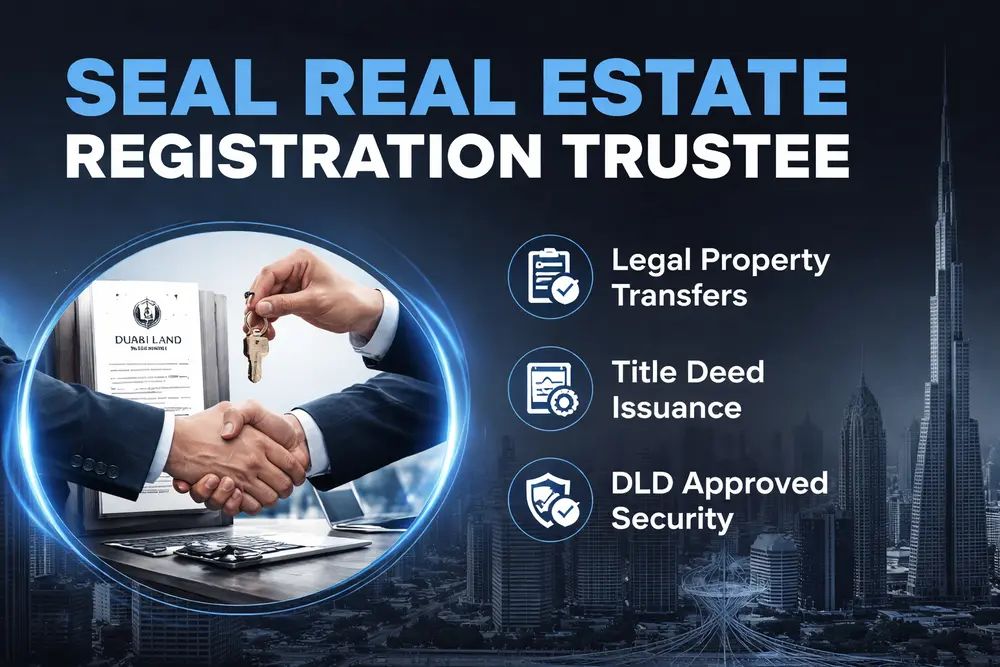
Seal Real Estate Registration Trustee in Dubai ensures legal property transfer, title deed issuance, and secure ownership registration with DLD approval.
Article
Dubai’s real estate market is known for its transparency and robust regulatory framework. The Dubai Land Department (DLD) maintains an up-to-date, publicly available database and regularly publishes reports that “underscore DLD’s commitment to fostering data transparency, innovation, and a world-class real estate ecosystem”. As part of this system, DLD authorizes private Registration Trustee Offices to process sales on its behalf. These trustee offices (like Seal Real Estate Registration Trustee) are licensed by DLD to handle the final paperwork and registration of property transfers. In effect, they serve as official service centers that help buyers and sellers complete real estate transactions securely and in full compliance with Dubai law.
Seal Real Estate Registration Trustee (often referred to as Seal Properties) is one of Dubai’s DLD-approved property registration offices. Seal’s website describes the company as “a one-stop shop for efficient property transfer registration solutions”. In practical terms, this means Seal’s team is licensed by the Dubai Land Department to assist with registering title transfers for sales, gifts, mortgages and related transactions. When you use Seal (or any DLD-licensed trustee), you are working with a legal agent of the government – not a private intermediary – whose job is to process your paperwork, collect official fees, and submit documents to DLD on your behalf. Like all approved trustees, Seal works under strict DLD guidelines to ensure that every sale or transfer is completed correctly and transparently.
Trustee offices play a vital role in protecting both buyers and sellers. They ensure ownership protection by verifying that only the true owner (seller) and the legitimate buyer sign the transfer documents. The trustee staff carefully check passports, Emirates IDs, title deeds and sales agreements to prevent any fraudulent or mistaken transfers. Because trustees are regulated by DLD, they guarantee compliance with all formal requirements. For example, they obtain any required developer “no objection certificates” and make sure the sale meets all Dubai Land Department rules.
Using a trustee also enhances transparency and security. All required transaction details are entered into DLD’s digital system and audited by the trustee staff, which means the government has a clear, instant record of every sale. Trustees collect the official transfer fees and additional charges for the title deed and mapping, then remit them directly to DLD. In this way, the flow of funds is managed through regulated channels (often via a DLD-managed escrow account) and both buyer and seller receive official receipts. By acting as a neutral, licensed party, the trustee provides peace of mind: you know the sale will be done correctly and that your funds and ownership rights are protected.
The Dubai Land Department is the government authority that sets the rules and ultimately issues title deeds, but most routine transfer work is handled by the trustee offices. In practice, buyers and sellers rarely visit the DLD main branch. Instead, they meet at a DLD-approved trustee office for the final transfer appointment. As one expert notes, this meeting “happens either directly at a Dubai Land Department (DLD) branch or, more commonly these days, at a DLD-approved Trustee Office”. These trustee centers are essentially extensions of DLD – authorized third parties that perform the same official functions in a more customer-friendly setting.
In other words, DLD sets policy but trustee offices execute it. The DLD headquarters maintains the property registry and generates the electronic title deed, while trustee offices verify documents, collect payments, and submit everything into DLD’s system. This division of labor makes the process more convenient: you can use any licensed trustee across the city instead of waiting at a government office. It also spreads out the workload so that registration can be done quickly and efficiently. (Trustee offices can even interact directly with banks and developers – for mortgages or no-objection certificates – on your behalf.) Ultimately, whether you go to DLD or an approved trustee office, the end result is the same: a legally registered transfer and a new title deed issued in the buyer’s name.
Dubai’s approved registration trustees (including Seal) offer a full range of property-related services. In addition to standard sales, they can handle:
In addition, trustees often handle related tasks like registering company share transfers of real estate, confirming inheritance transfers, or registering new usufruct/leasehold rights. They may also help with Ejari (rental) services tied to ownership contracts. Essentially, if it involves registering a change in property rights or financing with the DLD, a trustee office can do it. Seal Properties, for example, advertises services for selling under construction (off-plan sales), various lease-to-own contracts, and other specialized DLD procedures.
The Dubai Land Department provides clear guidance on how a sale is registered through a trustee office. In general, the process follows these steps:
Each of these steps is done under DLD’s rules. In practice, a well-run trustee office can complete the entire process (from document check to e-title issuance) in a matter of minutes. Once done, the buyer is the official owner on record, with an up-to-date title deed issued by DLD.
All registration fees in Dubai are set by the Dubai Land Department and are collected by the trustee on DLD’s behalf. In a typical residential sale, there is a fixed transfer fee (a percentage of the sale price) that both seller and buyer pay. In addition, official charges include a title-deed issuance fee and a map fee (for Dubai Municipality or other planning authorities), along with nominal knowledge and innovation fees that fund government services. For example, the DLD schedule lists small flat fees for issuing the new deed and for providing the updated land map.
Trustee offices handle all these payments transparently. They present a clear invoice listing each DLD fee line item (without any hidden costs). Buyers and sellers pay these to the trustee, and the trustee transfers them to DLD or its partners. (Some trustees also charge a modest service fee on top of the government fees; this is officially regulated and must be disclosed upfront.) In short, all charges are official and fixed by law, and the trustee simply collects them and provides receipts. Buyers should never pay any extra fees outside the official structure – all legitimate fees are shown on your DLD receipt.
Anyone buying or selling property in Dubai is legally required to use an approved registration trustee. This includes UAE nationals, residents, and foreign investors alike. Whether you are purchasing a freehold villa as an expat or a Dubai Land Department leasehold unit through a company, the transfer must be registered through a trustee office. There are no exemptions for foreigners; in fact, trustee offices often make the process easier for overseas buyers by arranging remote or proxy registration.
In practice, this means all property transactions – from a cash resale to an off-plan investment – go through a trustee. The system is mandatory and uniform. The trustee ensures the buyer pays the government fees (often 4% of price, split between buyer and seller) and that the official deed is issued. Even if you hire a real estate agent or lawyer, the final title transfer step must be done at a trustee office (or DLD branch). Foreign buyers can even complete this from abroad via Power of Attorney and video verification, but a trustee must still finalize the deal on DLD’s system.
Trustee offices are an essential part of Dubai’s property infrastructure. By having numerous licensed offices across the city, the DLD can process far more transactions than it could through a single central registry. Buyers and sellers benefit from shorter wait times and more appointment options. In fact, transactions are usually conducted at a nearby trustee center rather than the crowded main office. These offices are often located in business hubs and open long hours, making it convenient for parties involved. All trustee offices are listed on the DLD website, allowing customers to find the nearest one.
Beyond convenience, trustees coordinate the many aspects of a sale. They liaise with banks to register mortgages, obtain developer NOCs, arrange condo or rental clearances, and ensure every partner in the deal is satisfied. In this way, trustees serve as a hub connecting buyers, sellers, lenders and government agencies. This structure supports Dubai’s reputation for openness: every approved sale passes through the same digital workflow, ensuring accuracy and traceability. In line with Dubai’s smart-city goals, DLD is even working on AI and blockchain tools for registration, so the trustee-assisted process keeps getting faster and more secure.
Several myths can confuse buyers in Dubai. One is that signing the Sales & Purchase Agreement (SPA) immediately grants ownership. In fact, legal ownership only changes hands when the sale is registered with DLD through the trustee office. Until the title deed is re-issued in the buyer’s name, the seller remains the official owner. An SPA is simply a binding contract; it does not transfer title by itself. Another misconception is that registration can be easily skipped or delayed – DLD actually requires timely completion (typically within a few days of signing) to avoid fines.
Some also mix up the roles of DLD and the trustee. Remember: the DLD is the government land registry, while trustee offices are its authorized service points. Neither party is an “owner” of your property – they are just enforcing the official process. In fact, the final signing can happen at either venue, but most people do it at a trustee because it is faster and more convenient. Finally, beware of anyone who promises ownership without proper registration; without the trustee filing the transfer, the DLD database will show the old owner regardless of what documents you have. Always complete the sale through a licensed trustee to ensure full legal transfer.
Because all approved trustees follow the same government procedures, choosing one comes down to service and convenience. First, always verify that the office is on DLD’s official list of approved trustees. All legitimate offices (including Seal, Tamleek, Tawtheeq, Injaz, etc.) are listed on the Dubai Land Department website.
Next, consider location. Pick a trustee office that is close to your property or easy for you to reach. Dubai has trustee centers in many areas (Business Bay, Dubai Internet City, Downtown, etc.), so using a local one saves travel time. Also check operating hours – some offices have extended hours on weekdays.
Then, look at reputation and service quality. Since service fees are regulated, focus on how efficiently and politely the staff handle your case. Ask your agent or recent buyers for recommendations. An experienced trustee will proactively ensure all forms are correct and will communicate clearly about what’s needed.
Finally, ask about fees up front. The trustee’s own service fee should be modest and fully disclosed; it is separate from the fixed DLD fees. A transparent office will provide an itemized breakdown of all charges. In summary: use any DLD-approved trustee, but prioritize ones that are convenient, well-regarded, and helpful. A good trustee can significantly smooth out the last steps of your transaction.
Using a registered trustee office brings clear benefits to both parties. For buyers, the biggest advantage is legal certainty: the trustee makes sure the property is transferred correctly and promptly, so the new title deed is issued in your name. Funds can also be secured in an official escrow (managed by DLD) until the deal closes, protecting you from a seller taking off with money without handing over the deed. For sellers, working with a trustee ensures the sale is honored by the government only after payment is confirmed, so you don’t transfer ownership prematurely.
Both buyers and sellers benefit from speed and accuracy. Trustee staff are specialists in the process, so they catch any errors before submission. This avoids delays that might occur if a buyer tried to deal directly with the registry. In fact, DLD notes that approved trustees streamline all paperwork and compliance. The trustee also acts as a neutral intermediary, which can reassure all sides that the process is fair. In short, using a trustee makes the sale faster, error-free, and more transparent for everyone involved. It turns a complex legal procedure into a smooth, standardized transaction under the watchful eye of the regulator.
Dubai is at the forefront of modernizing its property registry. One innovation is the electronic title deed. Once a sale is registered, DLD issues the new title instantly in digital form. Buyers can retrieve the updated e-title via the Dubai REST app or receive it by email, without needing a paper certificate. This makes ownership verification quick and hassle-free.
The DLD has also enabled a remote registration system. Buyers and sellers no longer need to be physically present in Dubai to complete a transaction. Instead, the details are sent to the trustee, identities are confirmed by audio-visual call, and the entire sale – including money transfer through an escrow account – can be done online. After verification, DLD automatically finalizes the transfer and the e-title deed is granted to the buyer. This system (launched in 2020) has already processed hundreds of transactions securely from abroad.
Perhaps the most futuristic development is blockchain tokenization. In 2025 DLD launched the world’s first “Property Token Ownership Certificate” on a blockchain platform. This initiative allows properties to be divided into digital tokens, enabling fractional ownership and attracting new types of investors. It reflects a broader strategy: by recording property rights on blockchain, Dubai aims to further increase transparency and accessibility of real estate investments.
The Seal Real Estate Registration Trustee plays a vital role in maintaining transparency, legality, and investor protection within Dubai’s real estate market. By acting on behalf of the Dubai Land Department, these authorized offices ensure that every property transaction — whether a sale, mortgage, or gift transfer — is officially recorded and legally valid. This structured system protects buyers and sellers, reduces fraud risks, and strengthens confidence in Dubai’s property sector.
For investors and homeowners alike, completing the registration process through an approved trustee office is not just a formality but a critical legal step that secures ownership rights. Beyond registration, smart property owners also consider additional safeguards such as Property All Risk Insurance Dubai to protect their investment against unforeseen events, ensuring both legal and financial security.
In a market known for its innovation and strong regulatory framework, the Seal Real Estate Registration Trustee system continues to support smooth, secure, and reliable property transactions — making Dubai one of the safest and most attractive real estate destinations globally.
Latest Blogs
Jul 26, 2026

Jul 21, 2026

Jul 19, 2026

Jul 14, 2026
Jul 12, 2026