
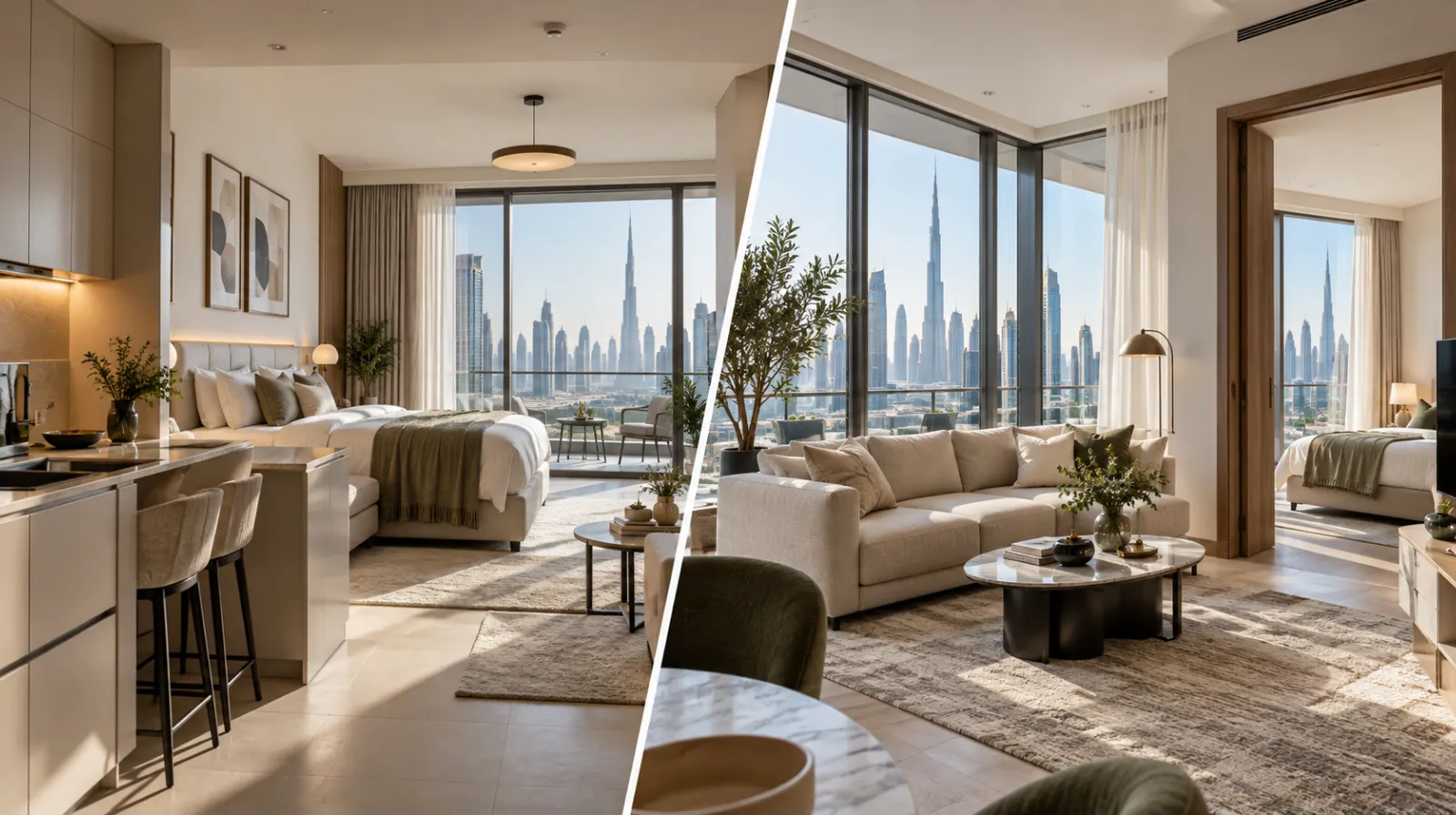
Studio vs 1-Bedroom Apartment Dubai Investment Guide
Oct 14, 2026
Blog Detail
Discover why Dubai’s real estate market is booming amid a global slowdown—driven by strong demand, tax perks, and visionary planning.
Article
Dubai’s real estate market has defied global economic headwinds, continuing to surge even as other markets cool. While many countries face high interest rates and slower growth, Dubai stands out as a resilient and booming property hub. This thriving market is underpinned by strategic government policies, strong economic fundamentals, and a unique appeal to international investors. For foreign buyers and investors, understanding the key reasons behind Dubai’s sustained real estate growth is crucial to appreciating why the emirate remains a safe, lucrative, and future-ready property market even amid a global slowdown.
Around the world, rising inflation and interest rates have dampened real estate activity – but not so in Dubai. Higher borrowing costs that cooled property markets in the US and Europe have had a limited impact on Dubai because an overwhelming share of buyers purchase in cash. In fact, more than 70% of UAE property transactions are cash sales (versus roughly 20-30% in Western markets), insulating Dubai from rate hikes. Additionally, strong oil revenues in the region and abundant sovereign wealth have insulated the Gulf from global economic headwinds. These factors have allowed Dubai’s real estate sector to maintain momentum, with transaction volumes remaining robust despite worldwide tightening.
Equally important, Dubai emerged from the pandemic as a safe haven for people and capital, attracting a renewed wave of migration and investment. Global “push” factors – from lockdowns and high taxes to political instability and conflict – have driven wealthy individuals and professionals to seek the stability Dubai offers. The UAE’s proactive response, including business-friendly reforms and flexible visa options, positioned Dubai as an attractive refuge during uncertain times. As a result, new residents have flocked to Dubai, fueling housing demand and keeping the property market buoyant even as other markets falter.
Dubai’s broader economic strength and surging population form a healthy foundation for its real estate growth. Unlike stagnating economies elsewhere, Dubai’s GDP continues to expand at a solid pace – roughly 3-5% annually in recent years. Non-oil sectors such as tourism, finance, construction and real estate itself are driving this growth, supported by modest inflation and investor confidence. This economic vitality bolsters employment and incomes, empowering more people to invest in homes and offices.
Just as crucial is Dubai’s population boom. The city’s population passed 3.5 million in 2023 and is growing by over 3% per year, spurred by an influx of expatriates and high-net-worth individuals drawn to the emirate’s opportunities. Government projections target about 5.8–5.9 million residents by 2040, implying roughly 100,000 new residents each year. This steady stream of new people – from entrepreneurs and skilled professionals to affluent families – translates directly into housing demand. It’s basic supply and demand: as one property expert noted, Dubai’s rapid population growth is “definitely” affecting prices, creating competition for available homes. Certain villa communities, for example, have seen values triple since 2020 amid a post-pandemic preference for larger homes and a limited supply of new villas. Overall, the emirate’s expanding populace and buyer base provide organic demand that underpins property values, helping Dubai avoid the glut-induced downturns seen in past cycles.
Fueling Dubai’s real estate resilience is a suite of government policies and long-term plans designed to foster sustainable growth. The city has deliberately shifted its property market onto a stable, demand-driven trajectory. Developers today launch projects in line with real demand, and speculation has taken a back seat to long-term investment value. This contrasts sharply with the boom-and-bust of earlier eras and reflects Dubai’s maturing regulatory framework. Transparent oversight by the Dubai Land Department (DLD) and initiatives like escrow accounts have instilled confidence, ensuring investors that the market is well-governed and their rights protected.
Crucially, Dubai’s leadership has articulated an ambitious vision for the future that bolsters investor trust. The newly unveiled Dubai Economic Agenda (D33) aims to double the size of the emirate’s economy by 2033, rolling out over 100 transformational projects across industries. In the real estate sector, this vision is already taking shape: Dubai approved a Real Estate Strategy 2033 that aligns with D33’s goals by targeting AED 1 trillion in property transactions by 2033 and doubling the property sector’s contribution to the economy. Such initiatives send a clear message that Dubai is committed to sustained growth and is investing in infrastructure, innovation, and livability for decades to come. From massive urban master plans (like the Dubai 2040 Urban Master Plan) to new free zones and smart city projects, long-range planning is expanding the city’s capacity and opening new investment frontiers. For investors, this visionary approach means buying in Dubai is not just about current market conditions, but about participating in a dynamic city of the future.
Equally impactful are pro-business reforms that have made it easier for foreigners to live, work, and invest in Dubai. The government has introduced Golden Visas (5- and 10-year residency permits) for substantial investors, entrepreneurs, and specialized professionals, encouraging longer-term settlement for those who purchase property. Foreign ownership restrictions have been liberalized, with expatriates now able to own 100% of companies and buy freehold property in many areas. These measures, along with business-friendly regulation, have reshaped sentiment in the real estate market. As industry observers note, policies like the Golden Visa and other residency reforms are turning long-time renters into homeowners, as skilled expats gain the confidence to put down roots in Dubai. Major government investments in infrastructure – from world-class airports and ports to new transport links – further amplify real estate demand by enhancing Dubai’s connectivity and livability. In short, forward-thinking governance and strategic planning have set the stage for enduring growth, making Dubai’s property sector remarkably resilient amid global uncertainty.
Dubai offers something foreign investors won’t find in most major markets: a virtually tax-free investment environment. Many international buyers initially wonder, Is There Property Tax in Dubai? The answer is a resounding no. Aside from a one-time transaction fee (the 4% title registration fee) and modest maintenance charges, there are no recurring property taxes in Dubai – no annual real estate levy, no capital gains tax on sales, and no rental income tax. This favorable tax regime makes a huge difference to investment returns. In cities like New York or London, property owners face hefty yearly taxes and transaction duties that can significantly erode profits. By contrast, Dubai’s lack of such taxes allows investors to keep more of their rental yields and capital appreciation, boosting the appeal of owning property as a long-term store of wealth.
Moreover, Dubai imposes no personal income tax, and its new federal corporate tax (introduced in 2023) specifically exempts individuals’ real estate investments. As one expert put it, the emirate’s limited taxation – no income tax and only a low 9% corporate tax on businesses – is a key reason global investors are optimistic about Dubai’s property sector. The tax advantages give Dubai a decided edge over other cosmopolitan centers. Investors from Europe, Asia and the Americas are drawn by the prospect of a high-growth market where the government won’t take a cut of their rental income or resale gains. When combined with relatively low buying costs and streamlined transaction procedures, these incentives cement Dubai’s reputation as one of the world’s most investor-friendly real estate markets.
In an era of uncertainty, Dubai has solidified its status as a safe haven for global wealth and talent. Wealthy individuals, entrepreneurs, and multinational companies increasingly view Dubai as a stable base amid geopolitical tensions and economic volatility elsewhere. The ongoing conflict in Europe, higher taxes in Western countries, and even changing immigration policies (such as stricter U.S. visa rules) have prompted many to relocate to Dubai for stability and growth. In 2022, Dubai was forecast to lead the world in attracting ultra-high-net-worth individuals, surpassing traditional destinations like the US or UK. This influx of millionaires and billionaires has supercharged demand for luxury real estate, from beachfront villas to penthouses in the sky. In 2025, sales of homes priced above $10 million surged to roughly $2.6 billion in just one quarter, as global buyers poured capital into Dubai’s prime properties. For the elite, Dubai offers not only lavish homes but also a lifestyle of security, privacy, and world-class amenities – all in a city that welcomes foreign ownership. It’s telling that Dubai now ranks among the world’s top 20 wealthiest cities by resident millionaires, with over 80,000 millionaires calling it home. These affluent residents, whether from Europe, Asia, Africa or the Middle East, continue to invest heavily in local real estate, confident in Dubai’s long-term stability.
Importantly, it’s not just the ultra-rich finding a haven in Dubai – the city’s appeal spans a broad spectrum of investors and skilled professionals. Thanks to its central geographic position, Dubai serves as a gateway between Asia, Europe, and Africa, drawing businesses and talent from all three continents. Global companies are expanding their regional hubs in Dubai, bringing in employees who often decide to purchase homes. At the same time, entrepreneurs and remote workers are relocating to take advantage of Dubai’s dynamic business climate and high quality of life. The absence of bureaucratic hurdles (relative to other major cities) and the ease of integrating into a cosmopolitan community make relocation attractive. Additionally, Dubai’s reputation as one of the world’s safest cities, with low crime and a family-friendly environment, gives foreign buyers peace of mind that their investments – and their loved ones – are secure. All these factors reinforce Dubai’s image as a refuge of opportunity, where buying property is not just a financial decision but a step toward a better life for many international investors.
From a pure investment standpoint, Dubai’s real estate offers exceptional returns and value that are hard to find in other global cities. Rental yields in Dubai average about 6-8%, far outshining cities like London (2-3.5%) or New York (3-5%). In some popular communities, landlords can achieve even higher returns – for instance, small apartments in areas like Jumeirah Village Circle or International City often generate rental yields above 8%. These high yields reflect genuine end-user demand (families and professionals needing homes) rather than speculative Airbnb-style rentals. For investors focused on income, Dubai’s robust rental market is a major draw, delivering strong cash flows in an era when many prime markets have razor-thin rental margins.
Property values in Dubai also remain competitive on the world stage, underscoring the emirate’s value proposition. Despite rapid growth since 2021, Dubai’s prices are generally lower per square foot than those in New York, London, Hong Kong or Singapore. As one industry CEO pointed out, a two-bedroom apartment in a prime Dubai district like Downtown might cost around AED 2.5 million (≈$680,000), which is a fraction of the price in London’s city center. Even the most exclusive Dubai addresses (Emirates Hills, Palm Jumeirah, etc.) offer more space for the money compared to other global hubs. This comparative affordability, combined with the luxury lifestyle and modern infrastructure Dubai provides, convinces many foreign buyers that Dubai real estate is “good value” for a global city. In fact, a UBS Global Real Estate study in 2022 rated Dubai as one of the best-value property markets worldwide.
Another sign of Dubai’s market maturity is the improved balance between supply and demand. Rather than the volatile oversupply cycles of the past, developers now take a measured approach, releasing projects in phases and focusing on master-planned communities that ensure quality of life. Government regulators closely monitor the pipeline to prevent extreme gluts, and there’s growing demand for completed (ready) homes among both middle-class end-users and the super-rich, which helps stabilize prices. Indeed, analysts note there are no clear “bubble” indicators in Dubai today – overall price levels in the mid-market remain below the last peak in 2014, even after recent gains. The luxury segment is booming, but that’s part of a normal mature market where prime and mass-market sectors diverge in performance. Meanwhile, the average residential yield of ~6-7% is a healthy sign that rents are keeping up with prices, unlike in overheated markets. All these factors suggest a sustainable growth trajectory rather than an unsustainable spike.
Perhaps most encouraging for investors is the transparency and data-driven insight now available in Dubai’s real estate. Detailed transaction databases and PropTech tools (like online price indices and valuation apps) give buyers unprecedented clarity into market conditions. This has replaced the uncertainty of the past with confidence – investors can make informed decisions based on real numbers, and that has attracted institutional investors and funds to Dubai in addition to individuals. As the CEO of a top property portal observed, the synergy of forward-thinking policy and digital progress has made Dubai’s market more inclusive and transparent, keeping global investor confidence strong.
In summary, Dubai’s real estate sector is thriving against the odds due to a perfect storm of positive factors. Strategic government action – from economic diversification under Dubai Economic Agenda D33 to visa reforms and infrastructure expansion – has created a solid bedrock for growth. Layered on this is the emirate’s investor-friendly milieu of zero property taxes and high yields, which few global cities can match. Add in the powerful demand drivers of a rising population, an influx of international wealth and talent, and Dubai’s reputation as a safe, high-quality place to live, and it becomes clear why the property market here continues to accelerate. Even as the world economy faces turbulence, Dubai has positioned itself as a beacon of stability and opportunity, with real estate as one of its core pillars.
For foreign investors contemplating where to deploy capital, Dubai offers a compelling case. It is a market where long-term prospects remain upbeat – analysts expect Dubai to outperform many global peers in the coming years – yet it also provides tangible near-term returns through strong rental income and ongoing price appreciation. The city’s leaders remain committed to sustainable development, aiming to accommodate significant future growth in population and business activity. All this means that Dubai’s real estate sector is not a speculative bubble tied to global liquidity; rather, it’s underpinned by real demand and visionary planning. In the face of a global slowdown, Dubai has emerged as a resilient and attractive real estate market – one that continues to beckon foreign investors with its unique combination of growth, security, and innovation
Latest Blogs
Oct 14, 2026
Oct 12, 2026
Oct 10, 2026
Sep 30, 2026
Sep 28, 2026