
Rising Construction Costs and Dubai Property Prices: What Buyers Need to Know
Sep 18, 2026
Blog Detail
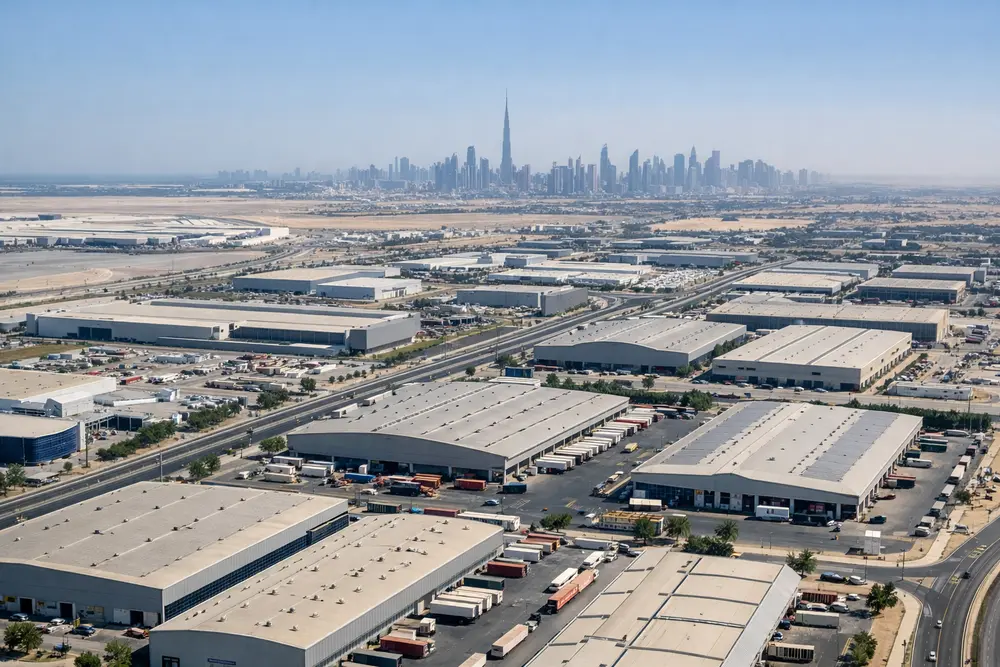
Dubai Logistics City is a prime industrial hub in Dubai South offering warehouses, strong connectivity, and high investment potential.
Article
Dubai Logistics City sits within the Dubai South master-planned urban ecosystem built around Al Maktoum International Airport (DWC), and it is engineered to function as a high-speed, multi-modal gateway for the Middle East, Africa, and South Asia as well as wider global trade lanes. Dubai South’s logistics proposition is strengthened by proximity to Jebel Ali Port and the existence of bonded logistics connectivity that is explicitly designed to reduce friction between sea and air cargo movements.
The “why” for occupiers and investors can be summarized in three practical points. First, the district is built to plug directly into major transport infrastructure: airport cargo capacity expansion at DWC (planned in phases into the 2030s), Jebel Ali Port’s high-throughput container and breakbulk operations, and the UAE’s national rail freight network connecting key ports and logistics centers (including Jebel Ali).
Second, Dubai Logistics City benefits from a regulatory environment tailored to logistics: a free zone framework with licensing and lease requirements, customs digitization via Dubai Customs’ Mirsal 2, and a customs bonded area concept that supports faster “in-bond” cargo handling and re-export models.
Third, the area’s tenant mix and new supply pipeline signal the kind of demand it targets: global integrators and forwarders (e.g., FedEx, UPS, Expeditors) and large-scale logistics operators (e.g., Toll Group/CWT-SML), alongside SMEs and e-commerce businesses that benefit from flexible, temperature-controlled units and an e-commerce-dedicated cluster (EZDubai).
Dubai Logistics City derives strategic value from its placement inside Dubai South—a large master-planned development anchored around Al Maktoum International Airport and explicitly structured around districts such as Logistics District and Aviation District. This “airport-centric city” logic matters in logistics because it compresses the distance (and therefore time) between cargo handling, warehousing, and onward distribution.
A core differentiator is the multi-modal convergence that Dubai authorities and operators repeatedly emphasize: the Logistics District is positioned to connect air cargo at DWC with sea freight at Jebel Ali Port and the UAE’s wider transport network, including major roads. Government communications about Dubai South’s Logistics District describe bonded access to Jebel Ali Port, direct access to DWC cargo terminals, and “uninterrupted” connectivity through a bonded logistics corridor—an explicit attempt to remove cargo flow “handovers” that typically slow sea-air routing.
This strategic logic is reinforced by the Dubai Logistics Corridor concept, described by Jebel Ali Free Zone (Jafza) as a single customs-bonded area spanning the port-free zone-airport ecosystem. Jafza’s guide highlights that the corridor bridges Jebel Ali Port, Jafza, and Al Maktoum International Airport, and it is designed to cut sea-air transfer time to under an hour by eliminating repeated entry/exit processes between zones.
Finally, strategic importance is increasingly tied to “future capacity." Dubai Airports notes that DWC cargo operations began in 2010 and passenger operations in 2013 and that the Dubai government announced a further expansion program in 2024 intended to scale DWC’s long-term passenger and cargo capacity dramatically. Dubai Media Office statements also frame the airport expansion as a long-horizon project with early 2030s delivery phases, explicitly linking it to integrated transport systems and the emirate’s role as a global gateway.
Dubai Logistics City supports global trade by acting as a trade facilitation “machine” rather than simply a collection of warehouses. The mechanics start with connectivity: sea freight arriving at Jebel Ali can be shifted into air cargo routings through a bonded corridor model, while time-sensitive air cargo can be consolidated, stored, or value-added (labelling, kitting, pick-and-pack) in proximity to cargo terminals. That proposition is reflected in Dubai South’s own messaging around seamless access to Jebel Ali Port via bonded logistics connectivity and direct access to airport cargo terminals.
The scale of global trade moving through the adjacent seaport ecosystem is material evidence of why the location works. Emirates News Agency (WAM) reported that Jebel Ali Port handled 15.5 million TEUs in 2024 (the highest throughput since 2015), while also recording strong breakbulk growth; the same source describes Jebel Ali as a leading regional trade and logistics hub and notes the port’s multi-terminal capacity and specialised cargo terminals. For occupiers in Dubai Logistics City, this translates into a nearby maritime gateway with substantial service breadth (containers, breakbulk, Ro-Ro/heavy-lift) that can feed re-export and regional distribution models.
On the “air side”, DWC’s expansion plans matter because air cargo economics improve when airports can sustain higher volumes and more integrated cargo infrastructure over time. Dubai Airports describes the DWC expansion vision in terms of multiple runways and significant long-term cargo capacity, while Dubai Aviation Engineering Projects (DAEP) frames the airport’s ultimate configuration as a “multi-modal cargo hub” enabling air-land-sea connection, with “crucial links” to the nearby Logistics District.
Trade facilitation also depends on customs and compliance. Dubai World Central (DWC) free zone rules require organizations undertaking commercial activity to hold a valid lease and registration/license, and they include detailed “goods and customs” provisions. The same rules specify that businesses moving goods in or out should register with Dubai Customs’ Mirsal 2 system, which enables online, paperless customs processing and supports pre-clearance—features that normally reduce administrative delays in high-volume operations.
Rail is a growing part of the global trade story, particularly for inland distribution and port-to-industrial connectivity. Etihad Rail (UAE National Railway Network) states that its network expansion spans around 900 km and that freight operations were launched across the UAE in 2023. Etihad Rail’s announcements also describe a structure of logistics centers and port connections—including Jebel Ali Port—supported by customs warehouses and cargo inspection services, strengthening the “port-to-hinterland” leg of supply chains over time.
Dubai Logistics City is designed for logistics-led value chains, and real-world occupier activity shows a mix of global integrators, third-party logistics (3PL), freight forwarding, e-commerce fulfillment, and trade-oriented businesses that rely on international connectivity. Dubai South’s own description of its Logistics District highlights that its facilities are aimed at warehousing, distribution, and logistics with scalable features for regional and international commerce—an “ecosystem” framing rather than a single-use industrial park.
Government announcements provide a clear picture of tenant profiles and service types. Dubai Media Office reports that UPS signed to open a facility in Dubai South’s Logistics District to strengthen trade connectivity through UPS’s global network, with completion and operational timing targeted within 2025.
Similarly, Dubai South announced the inauguration of a new facility in the Logistics District for Expeditors (a global logistics company), describing a service menu that includes warehousing and fulfillment, container freight station operations, inventory management, labeling/kitting, compliance inspections, return programs, pick-and-pack, and quality control. This is typical of modern 3PL/4PL operating models—where “value-added logistics” sits alongside transport management.
Another strong signal is the presence of hub-type operations tied to express and time-definite cargo. Dubai Media Office reports that FedEx inaugurated a regional air-and-ground hub at DWC in Dubai South, featuring automated sorting, AI-enabled scanning equipment, and dedicated cold storage space for temperature-sensitive shipments—elements strongly aligned with express parcels, high-value goods, and controlled-temperature logistics.
E-commerce is not an afterthought; it is structurally embedded through EZDubai. EZDubai describes itself as a fully dedicated e-commerce zone in Dubai South’s Logistics District, launched in 2019, offering both build-to-suit and ready facilities, streamlined licensing via a one-stop authority, dual-licensed/hybrid-bonded facilities, and an ecosystem designed for both B2B and B2C fulfillment locally and internationally.
Finally, large regional distribution hubs and specialized facilities are part of the mix. Dubai South and Toll Group’s announcement describes a new distribution center with pallet capacity, customized chambers, temperature-controlled storage, and a sustainability target (LEED Silver), supporting 3PL services and cross-border transportation across the wider region.
Property within Dubai Logistics City is best understood as a set of “operational formats” aligned with supply chain needs—ranging from small, combinable warehouse units to large build-to-suit campuses and serviced plots for bespoke development. Dubai South’s Logistics District marketing materials describe multiuser facilities and list warehouse specifications such as unit configurability, office space provisions, temperature control via district cooling, metering, and security access control.
A major recent addition is the multiuser facility model announced by Dubai South: combinable, air-conditioned, ground-access units in the freight forwarding zone, designed for SMEs and logistics/e-commerce/trading businesses, with completion and tenant handover targeted by Q1 2026. Importantly for sectors like pharmaceuticals, electronics, and premium consumer goods, Dubai South notes these units are temperature-controlled.
Beyond ready units, Dubai South’s planning and development guidance indicates that developers can rent serviced plots within the Logistics District, subject to an application to the authority and subsequent design, permit, and compliance steps. This is the pathway for companies that need a purpose-built distribution centre, cold chain facility, or hybrid warehousing/manufacturing space.
Specialised clusters add more options. EZDubai states it offers build-to-suit and ready purpose-built warehousing and offices with flexible lease terms, plus hybrid-bonded facilities and a dedicated e-commerce environment. For digital-first businesses, this reduces “time to launch” by packaging property, licensing, and operations support into one cluster.
From an investor/occupier perspective, the key practical choice is usually between: leasing ready operational space (fast deployment), leasing land (maximum customisation), or accessing specialised formats (e-commerce fulfilment, freight forwarding zones, or temperature-controlled distribution). Dubai South’s own logistics materials reference options including foreign ownership and “dual licensing of Free Zone and DED along Ejari”, suggesting pathways for businesses that need both free zone advantages and onshore commercial interface (subject to specific licensing conditions).
if your want explore more about floor plan, project detail go the homeland realty official website where you can explore more
In practice, most industrial “access” in Dubai Logistics City is structured around leasing (warehouses, facilities, and/or land), with the regulatory framework tying business operations to both a lease and an operating licence. DWC free zone rules explicitly state that organisations undertaking commercial activities must have a valid lease and a valid registration and licence (renewed annually). This reinforces a market reality: the right to occupy and operate is often packaged as a lease-plus-licence solution rather than pure real estate ownership.
That said, Dubai’s enabling legislation gives the operating corporation authority to lease or sell certain assets. Dubai Law No. 11 of 2015 (establishing the Dubai World Central Corporation) includes powers to construct buildings and warehouses and “lease out or sell them” (subject to required authorisations). This means outright sale can be legally available in the Dubai World Central ecosystem, but whether a specific industrial unit is offered “for sale” versus “for lease” depends on the specific project, zone rules, and authority approvals at the time. The most reliable step is to confirm the tenure structure directly with Dubai South/DWC or through an authorised channel before underwriting an acquisition.
From an investor’s standpoint, it is often more useful to analyse “control and monetisation” rather than only ownership. Leasing models can still allow long-term operational control, brand presence, and tenant income (if subleasing is permitted under the relevant rules), while ownership models can offer balance-sheet stability—but may come with tighter permitted-use and compliance conditions in logistics environments (especially where bonded handling or restricted goods are involved). The DWC rules and contents show that goods categories (including pharmaceuticals/medical goods and dangerous goods) fall under specific customs and compliance requirements.
The benefits cluster around speed, connectivity, and ecosystem depth. Dubai Logistics City is positioned to leverage Jebel Ali’s trade volumes and specialisation, while the bonded logistics corridor and digital customs systems are designed to reduce time lost to zone-to-zone transitions and paperwork. Tenant announcements (UPS, Expeditors, Toll Group and FedEx) illustrate continuing demand from global supply-chain brands—often a positive sign for long-term industrial occupancy fundamentals.
The risks are not unique to Dubai, but they are real. Logistics assets are exposed to global trade cycles, rerouting disruptions, and changing customer delivery expectations; even strong ports describe operating amid “supply chain disruptions”. Compliance intensity can also be higher than in standard commercial real estate, particularly for restricted, medical, or hazardous goods. Finally, competitive supply from other Dubai free zones (there are 20+ across the emirate) can affect pricing power and occupancy for undifferentiated “box” warehousing—making specification, location, and tenant targeting decisive.
Dubai Logistics City has become a flagship logistics location in the UAE because it combines three levers that rarely align at scale: proximity to a growing airport cargo platform (DWC), adjacency to a high-throughput global seaport ecosystem (Jebel Ali), and a regulatory structure built to support bonded and digitised trade flows. Recent announcements in Dubai South’s Logistics District—multiuser facilities scheduled for handover, plus new or expanded footprints for global operators—suggest the area is being actively developed to meet modern requirements such as temperature control, scalable units, and value-added fulfilment.
For investors, the “buy vs lease” question should be answered pragmatically: the framework strongly supports lease-based operating models (lease + licence), while legislation indicates that sale can be possible for certain assets when authorised. The right approach is to start with your supply chain model (bonded vs non-bonded, e-commerce vs freight forwarding, temperature-controlled vs ambient), then select the property format—ready unit, build-to-suit plot, or specialised cluster—and only then decide which tenure structure supports your required control and return profile.
Latest Blogs
Sep 18, 2026
Sep 15, 2026
Sep 12, 2026

Sep 9, 2026

Sep 5, 2026