
جزئیات منطقه
Dubai International Financial Centre (DIFC)
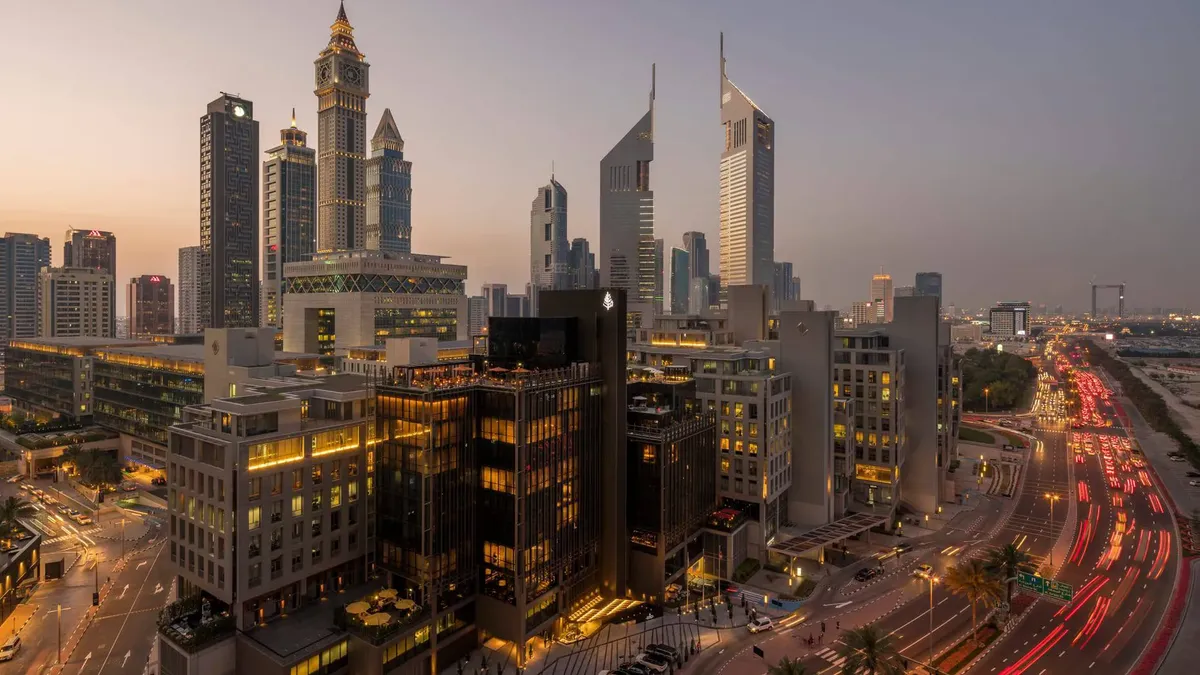
Dubai International Financial Centre (DIFC) is one of Dubai's most important business and financial districts and the leading financial centre in the Middle East, Africa and South Asia (MEASA) region. In addition to hosting banks, investment firms, financial institutions, asset management companies, FinTech firms and international corporations, DIFC has gradually developed into one of the most prominent luxury residential markets in central Dubai. By the end of H1 2026, the number of active registered companies in DIFC had reached 10,018, while the number of regulated financial services firms had increased to 1,134. This level of economic activity is one of the key drivers of sustained demand for office space and residential units located close to the workplace.
Dubai International Financial Centre (DIFC)
Dubai International Financial Centre (DIFC) is one of Dubai's most important business and financial districts and the leading financial centre in the Middle East, Africa and South Asia (MEASA) region. In addition to hosting banks, investment firms, financial institutions, asset management companies, FinTech firms and international corporations, DIFC has gradually developed into one of the most prominent luxury residential markets in central Dubai. By the end of H1 2026, the number of active registered companies in DIFC had reached 10,018, while the number of regulated financial services firms had increased to 1,134. This level of economic activity is one of the key drivers of sustained demand for office space and residential units located close to the workplace.
نمای کلی
خلاصه کوتاه
Dubai International Financial Centre (DIFC) is one of Dubai's most important business and financial districts and the leading financial centre in the Middle East, Africa and South Asia (MEASA) region. In addition to hosting banks, investment firms, financial institutions, asset management companies, FinTech firms and international corporations, DIFC has gradually developed into one of the most prominent luxury residential markets in central Dubai.
By the end of H1 2026, the number of active registered companies in DIFC had reached 10,018, while the number of regulated financial services firms had increased to 1,134. This level of economic activity is one of the key drivers of sustained demand for office space and residential units located close to the workplace.
راهنمای کامل
درباره Dubai International Financial Centre (DIFC)
Location & Accessibility
DIFC is located in one of Dubai's most central locations, along Sheikh Zayed Road between the Trade Centre district and Downtown Dubai. Its location provides convenient access to Downtown Dubai, Dubai Mall, Business Bay and Dubai International Airport.
For public transport, DIFC is accessible via the Dubai Metro Red Line, with Emirates Towers Metro Station and Financial Centre Metro Station serving the district. Emirates Towers Metro Station provides the more direct access to The Gate building.
DIFC District Structure
The current core of DIFC is made up of three key areas: Gate District, Gate Village and Gate Avenue. Together, they combine office space, restaurants, cafes, art galleries, retail outlets and everyday services within a relatively pedestrian-friendly urban environment.
Gate District is the commercial core surrounding the iconic The Gate building. Gate Village is best known for its upscale restaurants, art galleries and lifestyle offering, while Gate Avenue brings together retail, dining, services, wellness and public spaces.
DIFC Residential Market
Based on the transaction dataset provided, 215 residential transactions were recorded in the core DIFC community between 5 January and 9 July 2026.
| Metric | Recorded Market Data |
| Number of Transactions | 215 |
| Total Transaction Value | Approx. AED 1.48 billion |
| Average Transaction Value | Approx. AED 6.90 million |
| Median Transaction Value | AED 4.25 million |
| Average Price | AED 3,305 / sq. ft. |
| Median Price | AED 2,931 / sq. ft. |
| Average Transacted Area | Approx. 1,778 sq. ft. |
The gap between the average and median prices indicates that high-value transactions in Ultra-Prime projects have a material impact on the overall market average. Therefore, when discussing pricing with a client, the overall DIFC average should not be used in isolation; comparisons should be made at building level.
Transactions by Unit Type
| Unit Type | Transactions | Median Transaction Price | Median AED/sq. ft. |
| Studio | 23 | AED 1.43M | 2,318 |
| 1 Bedroom | 76 | AED 2.96M | 2,713 |
| 2 Bedroom | 81 | AED 5.40M | 3,101 |
| 3 Bedroom | 31 | AED 11.27M | 4,225 |
| 4 Bedroom | 2 | AED 30.18M | 5,168 |
| Penthouse | 2 | AED 38.90M | 4,497 |
The highest transaction volumes in the sample were recorded for 1 Bedroom and 2 Bedroom units. By contrast, 3 Bedroom units and above move into the High-End and Ultra-Prime segments, where both unit prices and price per sq. ft. increase materially.
DIFC Building Price Positioning
Transaction data shows that DIFC should not be treated as a single, uniform pricing market. There is a substantial price gap between older established buildings and newer Luxury developments.
Within the relatively Entry-Level segment, buildings such as Park Towers and Skygardens recorded lower prices per sq. ft. in the transactions reviewed. The mid-market range includes projects such as Liberty House, Ritz Carlton & Limestone House, Central Park and Index Tower.
At the higher end of the market are Burj Daman, DIFC Living, DIFC Heights and Eden House DIFC. The Ultra-Prime segment includes projects such as Four Seasons Private Residences DIFC and other new luxury residences that have recorded prices well above the district average.
For example, the average price recorded in the transaction sample was approximately AED 4,329/sq. ft. at Eden House and approximately AED 7,342/sq. ft. at Four Seasons Private Residences. A direct comparison between a unit in Park Towers and one in Four Seasons or Eden House is therefore not appropriate from a product-positioning perspective.
Residential Supply
Based on the Residential Supply file, 8 Existing projects with a combined total of approximately 2,868 units are recorded within the core DIFC area.
In addition to the existing stock, at least 618 units are recorded across Under Construction projects for which unit counts are specified in the dataset. This figure excludes projects where the dataset does not provide a full unit count; for example, Eden House and Janu Dubai have not been added to this total because their complete unit counts are not specified in the file.
Key projects currently under development include DIFC Heights Tower, DIFC Living and Innovation Two, Eden House DIFC, Four Seasons Private Residences DIFC, Janu Dubai and The Carlyle Residences.
This indicates that DIFC's residential market is evolving from a predominantly commercial CBD into a Mixed-Use Luxury District with a larger share of permanent residential use and branded/luxury residences.
Residential Occupancy
Based on the data provided, average Residential Occupancy in DIFC increased from approximately 84.9% in H2 2023 to 87.3% in H2 2025.
In H2 2025, selected established buildings recorded the following occupancy rates:
| Building | Occupancy H2 2025 |
| Park Tower 1 | 94% |
| Park Tower 2 | 92% |
| Skygardens | 90% |
| Central Park Residential | 86% |
| Liberty House | 86% |
| Ritz Carlton & Limestone House | 86% |
| Index Tower | 84% |
| Burj Daman | 80% |
For investors, this data is important because it shows that rental performance in DIFC does not depend on the district name alone. Building quality, unit quality, project age and positioning can all have a material impact on tenant demand and occupancy performance.
DIFC Office Market
The Office market is one of the key factors that differentiates DIFC from many other Mixed-Use districts in Dubai.
According to the Office Occupancy file, average office occupancy in DIFC increased from approximately 83.9% in H2 2021 to approximately 96.1% in H2 2025. A large number of buildings across Gate Precinct and Gate Village recorded 100% occupancy in H2 2025.
This demand pressure remained visible in 2026. DIFC announced that the new DIFC Square development, offering approximately 600,000 sq. ft. of Grade A office space, was 100% pre-leased prior to handover.
This is also relevant to the residential market, as growth in the number of companies and professionals working in the district can support additional demand for homes located close to the workplace.
DIFC Zabeel / DIFC 2.0
One of the most significant future developments for the district is DIFC Zabeel District, which was officially introduced in January 2026.
The expansion is planned as a large Mixed-Use ecosystem incorporating commercial offices, residential space, a hotel, retail, cultural facilities, a conference centre, an AI Campus and new urban infrastructure. DIFC has stated that the development programme has an estimated value of approximately AED 100 billion.
The first residential development in this area is The Residences DIFC Zabeel, which was introduced in February 2026. DIFC stated that the public release was fully sold out at launch.
In the transaction file provided, DIFC 2.0 is also recorded as a separate Community. Between 10 June and 9 July 2026, 192 transactions were recorded for The Residences DIFC Zabeel, with a combined transaction value of approximately AED 910.3 million.
The average price across these transactions was approximately AED 3,872/sq. ft., while the median price was approximately AED 3,827/sq. ft. The majority of transactions were for 1 Bedroom units, followed by 2 Bedroom units.
DIFC Core and DIFC Zabeel should therefore be analysed separately. Although both sit under the DIFC brand, they differ in development stage, inventory, product type and Price Discovery.
Who Is DIFC Best Suited For?
DIFC is particularly attractive to several client profiles:
- Professionals & Executives: Clients working in DIFC, Downtown Dubai, Trade Centre or Business Bay who value a short commute to their workplace.
- Luxury End Users: Clients who prefer urban living, upscale dining, premium services and a central location over living in villa communities.
- Property Investors: Investors focused on a CBD market, more limited land supply and demand supported by corporate employment.
- Ultra-Prime Buyers: Buyers targeting branded residences and products such as Four Seasons, Eden House, Janu or other new DIFC developments.
Corporate Office Clients: Financial institutions, wealth management firms, insurance companies, professional services businesses, FinTech firms and international companies for which a presence within an established Financial Centre provides a commercial advantage.
Key Strengths of the Area
DIFC's key advantage is its combination of Business + Residential + Lifestyle within a highly central location. The district is not solely dependent on tourism-driven demand; a significant share of demand is generated by real corporate activity, skilled professionals and the financial ecosystem.
In parallel, the development of new residential projects and DIFC Zabeel is transforming DIFC from a traditional Financial District into a more complete urban destination. Gate Village, Gate Avenue and Gate District also provide access to a broad mix of dining, retail, art and everyday services.
Key Notes for Property Consultants
The most important principle when selling or leasing property in DIFC is not to present the district using a single "average price". Pricing varies significantly between Park Towers, Skygardens, Index Tower, Burj Daman, Eden House and Four Seasons, with each targeting a different market segment.
For investors, the analysis should go beyond the acquisition price to include Occupancy, building quality, layout, View, ongoing costs and the unit's competitiveness in the rental market. For End Users, access to the workplace, urban lifestyle, building amenities and project age will generally carry greater weight.
There is also an important methodological point in the data provided: several projects listed as Under Construction in the Residential Supply file appear in the Transactions file with the Transaction Type "Sales - Ready". The Ready or Off-Plan status of each project should therefore be verified independently rather than relying solely on the Transaction Type field.
Consultant Summary
DIFC is not a typical Dubai apartment market; it is an international CBD with a Premium and Ultra-Premium residential market.
Very strong office demand, growth in the number of companies, a central location, a strong lifestyle offering and the arrival of a new generation of residential developments form the core of DIFC's appeal. At the same time, the wide variation in building quality and pricing means that successful purchasing or investment decisions depend more on selecting the right Building and Unit than on choosing the district alone.
For clients looking to live or invest in Dubai's economic heart, DIFC is one of the key districts to consider. However, the market should be analysed Building-by-Building and in line with the client's ultimate objective.
Frequently Asked Questions (FAQs)
1. What is DIFC best known for?
Dubai International Financial Centre (DIFC) is one of Dubai’s leading financial and business districts and a major financial hub for the Middle East, Africa and South Asia (MEASA) region. It combines a well-established corporate environment with premium residences, dining, retail, art and lifestyle amenities.
2. Is DIFC a good area to live in?
DIFC is particularly well suited to professionals, executives and residents who prefer a central, urban lifestyle with convenient access to workplaces, restaurants, retail and premium services. It is especially attractive to those working in DIFC, Downtown Dubai, Trade Centre or Business Bay.
3. Is DIFC a good area for property investment?
DIFC can be an attractive option for investors due to its central location, strong corporate presence and established demand from professionals and executives. However, investment performance varies considerably between buildings, so each property should be assessed based on its purchase price, achievable rent, occupancy, service charges, building quality and competing supply.
4. What is the average property price in DIFC?
Based on residential transactions recorded between 5 January and 9 July 2026, the average transaction price in DIFC was approximately AED 6.90 million, while the median transaction price was AED 4.25 million. The average price per square foot was approximately AED 3,305, compared with a median of AED 2,931 per sq. ft.
These community-wide figures should be used with caution because pricing varies significantly between established buildings and newer luxury or branded residences.
5. Which unit types are most commonly traded in DIFC?
Based on the transaction data reviewed, 1-bedroom and 2-bedroom apartments accounted for the highest number of residential transactions. Larger 3-bedroom apartments, 4-bedroom residences and penthouses generally fall within the high-end and ultra-prime segments of the market.
6. Which residential buildings are available in DIFC?
DIFC offers a broad range of residential products across different price segments. Established developments include Park Towers, Skygardens, Liberty House, Central Park, Index Tower and Burj Daman, while newer premium and luxury developments include DIFC Living, DIFC Heights, Eden House DIFC and Four Seasons Private Residences DIFC.
The properties should not be compared solely on location, as product quality, age, positioning, amenities and pricing differ substantially between buildings.
7. How strong is residential occupancy in DIFC?
The average residential occupancy rate in the provided data increased from approximately 84.9% in H2 2023 to 87.3% in H2 2025. Individual buildings recorded different occupancy levels, demonstrating that rental performance in DIFC depends not only on the area itself but also on the specific building and unit.
8. How strong is the office market in DIFC?
DIFC has one of the strongest office-market profiles among Dubai’s mixed-use districts. According to the provided data, average office occupancy increased from approximately 83.9% in H2 2021 to around 96.1% in H2 2025, with several buildings in Gate Precinct and Gate Village recording full occupancy.
The strength of the office market is also an important demand driver for nearby residential properties.
9. What is the difference between DIFC Core and DIFC Zabeel?
DIFC Core is the established financial and mixed-use district, while DIFC Zabeel, also referred to in the transaction data as DIFC 2.0, represents the newer expansion of DIFC.
Although both are part of the wider DIFC ecosystem, they should be analysed separately due to differences in development stage, product type, available supply, pricing and market maturity.
10. Is DIFC suitable for families?
DIFC may suit families who prefer apartment living, a central location and an urban lifestyle. However, its positioning is primarily business-oriented and premium urban rather than a traditional villa or suburban family community. The suitability of the area therefore depends on the family’s lifestyle priorities and preferred type of residence.