

Studio vs 1-Bedroom Apartment Dubai Investment Guide
Oct 14, 2026
جزئیات وبلاگ
Compare Dubai Maritime City vs Dubai Creek Harbour for investment, pricing logic, rental demand, risks, maturity, and buyer fit in this practical waterfront guide.
مقاله
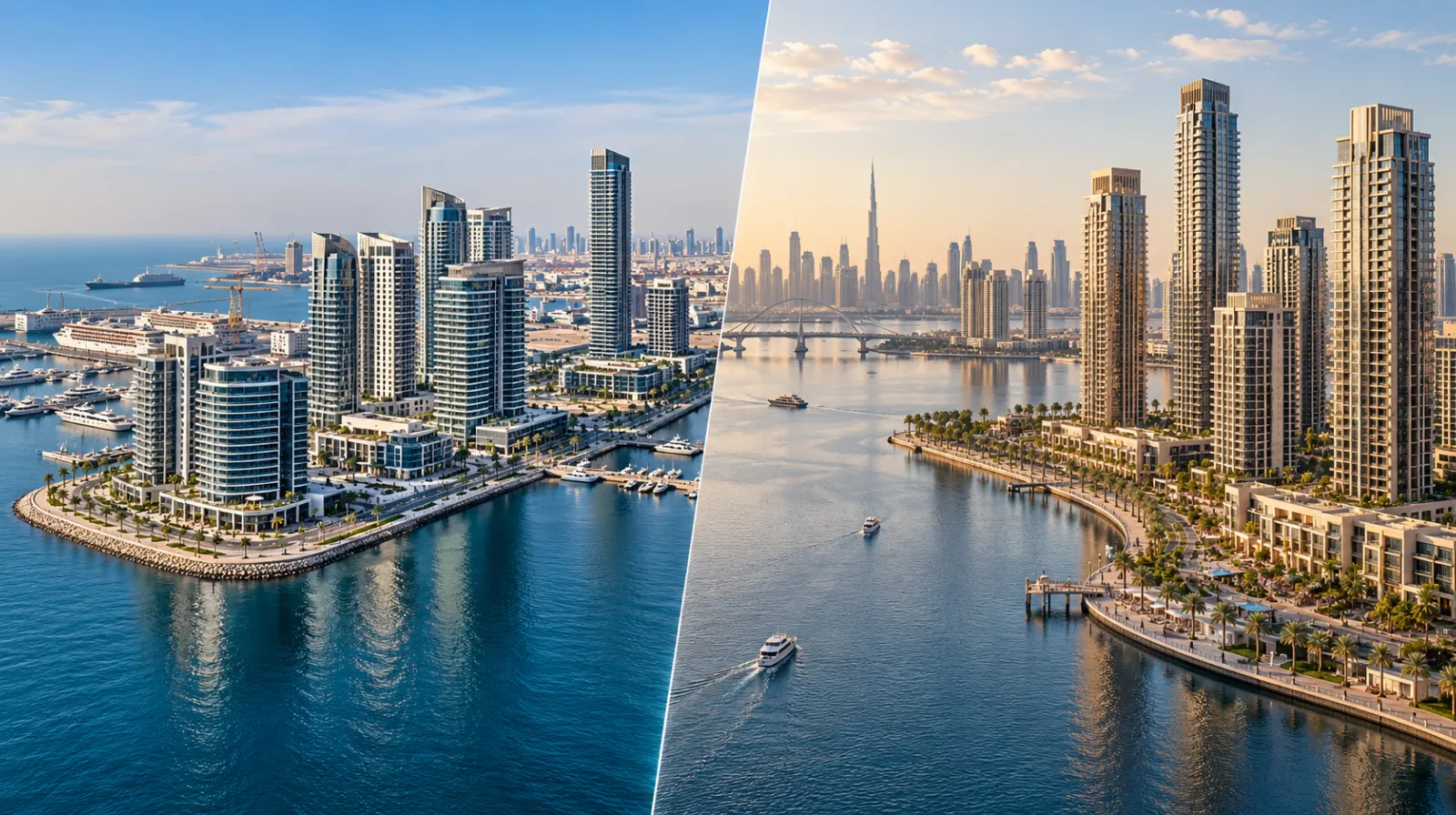
Dubai Maritime City vs Dubai Creek Harbour investment comes down to buyer fit, not a universal winner: Dubai Creek Harbour may suit buyers who want a more established residential setting today, while Dubai Maritime City may appeal more to buyers comfortable with an earlier-stage, development-led waterfront story. Both are waterfront markets, but they serve different profiles depending on budget, timeline, risk tolerance, and whether you value present-day community maturity or earlier-stage upside potential, so what should you compare before choosing between entry price, connectivity, development pipeline, rental demand, service charges, handover timing, and exit liquidity?
Key Takeaways
Both locations are waterfront plays, but they sit at different points on the maturity curve. Dubai Creek Harbour often presents as a more recognizable residential community today, while Dubai Maritime City can feel more project-driven and dependent on how each phase and surrounding infrastructure develops. That means any comparison should separate delivered reality from forward-looking potential.
| Comparison point | Dubai Maritime City | Dubai Creek Harbour |
| Location | Waterfront peninsula setting with practical proximity to older Dubai and key business districts | Waterfront master-planned setting with practical access to central Dubai corridors |
| Masterplan/developer structure | Maritime-focused area with a broader regulatory context tied to Dubai’s maritime sector | Large master-planned residential district; buyers should assess each sub-community and developer package separately |
| Property mix | Broadly includes apartments and branded or lifestyle-led stock based on market observations; requires project-level verification | Broadly includes apartments across delivered and pipeline stock; the mix varies by building and phase |
| Current price per sq ft | Unverified market check; compare only like-for-like units | Unverified market check; compare only like-for-like units |
| Typical unit budget | Requires unit-level verification | Requires unit-level verification |
| Payment plans | Check current reservation documents and sales contracts | Check current reservation documents and sales contracts |
| Handovers | Vary by project and phase; verify current construction status | Vary by project and phase; verify current construction status |
| Tenant profile | May appeal to tenants who value waterfront living near older Dubai and business districts, subject to project readiness | May appeal to tenants who want a more complete community feel, depending on the exact building and amenity access |
| Projected vs achieved rent | Requires unit-level verification; avoid relying on projected marketing rents | Requires unit-level verification; compare actual leasing evidence where available |
| Investment risk | Earlier-stage area risk, construction exposure, amenity ramp-up risk, and future-supply uncertainty | More mature-community profile, but still exposed to project-specific pricing, supply, and resale competition |
Foreign ownership rules in Dubai depend on designated areas and formal registration, and real estate registration in Dubai is handled by the relevant authority, so the title structure and registration pathway should be checked before commitment.
Dubai Maritime City is usually discussed as a waterfront peninsula opportunity with a different character from standard residential districts. Its location logic can appeal to buyers who want relative access to older Dubai, port-linked commercial activity, and established business areas without buying purely into a finished suburban-style community.
The area also has a specific maritime identity that matters for context. Dubai’s legal framework renamed the local maritime authority and reinforced the role of maritime-sector regulation and investment support across Dubai, which helps explain why the area carries a distinct institutional identity beyond simple residential branding.
From an investment angle, Dubai Maritime City property investment may attract buyers who are comfortable with development-stage uncertainty. In practical terms:
That last point matters. In an emerging district, the difference between one tower and another can be large because construction progress, nearby plots, road patterns, and amenity delivery can materially affect the ownership experience.
Dubai Creek Harbour usually appeals to buyers who want a waterfront district that already feels more recognizably residential. Compared with newer or less-complete waterfront zones, it can offer a clearer sense of community form, with more delivered stock and a more visible day-to-day living environment in some parts of the area.
For Dubai Creek Harbour property investment, the key practical question is not whether the area is established in branding terms, but which parts are already functioning as livable residential stock and which parts still depend on future delivery. In practical terms:
This is why Dubai Maritime City vs Dubai Creek Harbour is rarely a simple price question. Creek Harbour can appeal to buyers who want a more finished residential story today, but the value case still depends on the specific tower, view corridor, and price paid.
Price comparison only becomes useful when the units are genuinely comparable. A studio in an early-stage off-plan tower should not be treated as directly comparable to a larger delivered apartment with an open view and a different handover profile, even if both sit in waterfront districts.
A better method is to compare units using the same filters:
Why this matters:
If you are comparing Dubai waterfront property prices, avoid broad area averages. Instead, build a shortlist of matched units in both areas, then review what you are actually paying for: handover certainty, view protection, layout quality, and livability on day one.
Rental demand should be evaluated from the tenant’s point of view, not just the investor’s spreadsheet. In both areas, tenant demand can vary by building quality, furnishing level, commute pattern, current amenities, and whether the unit is better suited to long-term residents or shorter-stay users.
Likely demand patterns to test:
When thinking about net yield, remember that gross rent is only the starting point. You still need to consider:
Illustrative net-yield example only:
This is only a framework, not an area claim. A different building, amenity load, or rent level could change the result materially.
For lease formalities, tenants concluding a lease are generally expected to provide identification documents such as a passport copy, valid residence visa, and Emirates ID.
Capital growth and resale liquidity are related, but they are not the same. A unit may have an attractive future story yet still be harder to resell quickly if surrounding supply is heavy, the project is still early, or buyers have many similar alternatives.
When comparing the two areas, consider these drivers:
In broad terms, Dubai Creek Harbour may have an advantage for buyers who care about current secondary-market comfort, while Dubai Maritime City may attract buyers seeking earlier-stage upside potential. But neither conclusion should be made without checking the exact unit, nearby pipeline, and likely buyer pool on exit.
Connectivity is where many paper comparisons fail. A waterfront address can look attractive in marketing, but daily usability often comes down to road access, commute logic, nearby errands, and whether the area already functions comfortably without depending on future phases.
A practical comparison lens:
In simple terms, Dubai Creek Harbour may feel more complete today in some parts, while Dubai Maritime City may still feel more evolving depending on the project and surrounding plots.
Off-plan can widen your choices in both areas, but it also increases the importance of document-level verification. Payment plans, handover timing, construction status, and inventory availability can change, so the buyer should rely on current reservation documents, sales agreements, and official developer paperwork rather than generic area talk.
In practice, compare off-plan options by payment schedule shape, cancellation exposure, handover realism, construction progress, and what the building will compete against at completion. Payment plans and handover timing should always be checked against current reservation documents.
Waterfront investing can look simple at area level, but most of the real risk sits at project and unit level. A balanced comparison should make those risks visible before any reservation decision.
Key risks to check:
The main practical point is that risk is not identical across all projects within either area.
The better choice depends on your objective, your hold period, and how much early-stage risk you are willing to accept. The most reliable decision is made at unit level, not area level alone.
For many buyers, the smartest next step is to shortlist matched units in both locations and compare them line by line instead of trying to pick a winner in the abstract.
For a first purchase, Dubai Creek Harbour may feel easier to understand if you value a more established residential setting. Dubai Maritime City may fit better if you are comfortable with earlier-stage area evolution and are buying with a longer patience window.
In general, it often appears more established as a residential community. The practical test is simple: check delivered buildings, occupied stock, current amenities, and surrounding construction rather than relying on branding alone.
Foreigners and expatriate residents may acquire freehold ownership rights in Dubai in designated areas, and Dubai real estate registration is handled by the relevant authority. Buyers should still confirm that the exact property and title structure match the applicable rules before purchase.
A property purchase does not automatically guarantee approval. Real estate investors may be eligible for a 5-year Golden Visa if they meet the stated official conditions.
Dubai Creek Harbour may be easier for some long-term tenants if the building sits in a more complete daily-living environment. Dubai Maritime City can still perform well at unit level, but tenant response may depend more on immediate surroundings, access, and project readiness.
Compare size, floor, view, developer, completion status, handover date, service-charge exposure, nearby construction, contract terms, and likely resale depth. Do not compare unlike stock just because both units are in waterfront areas.
No. They can vary meaningfully by building design, amenity load, management setup, and unit type. That is why gross rent alone can give a misleading picture of actual returns.
When concluding a lease, tenants are generally expected to provide identification documents including a passport copy, valid residence visa, and Emirates ID.
Dubai Maritime City vs Dubai Creek Harbour investment is ultimately a choice between different risk-reward profiles, different stages of community maturity, and different unit-level trade-offs rather than a simple winner and loser. If you want to make a defensible waterfront decision, Homeland can help you build a structured comparison of shortlisted units, review the real differences behind pricing and livability, and match the final choice to your actual goal with transparency, market knowledge, and client-interest fit.
آخرین وبلاگها
Oct 14, 2026
Oct 10, 2026
Sep 30, 2026

Sep 28, 2026