
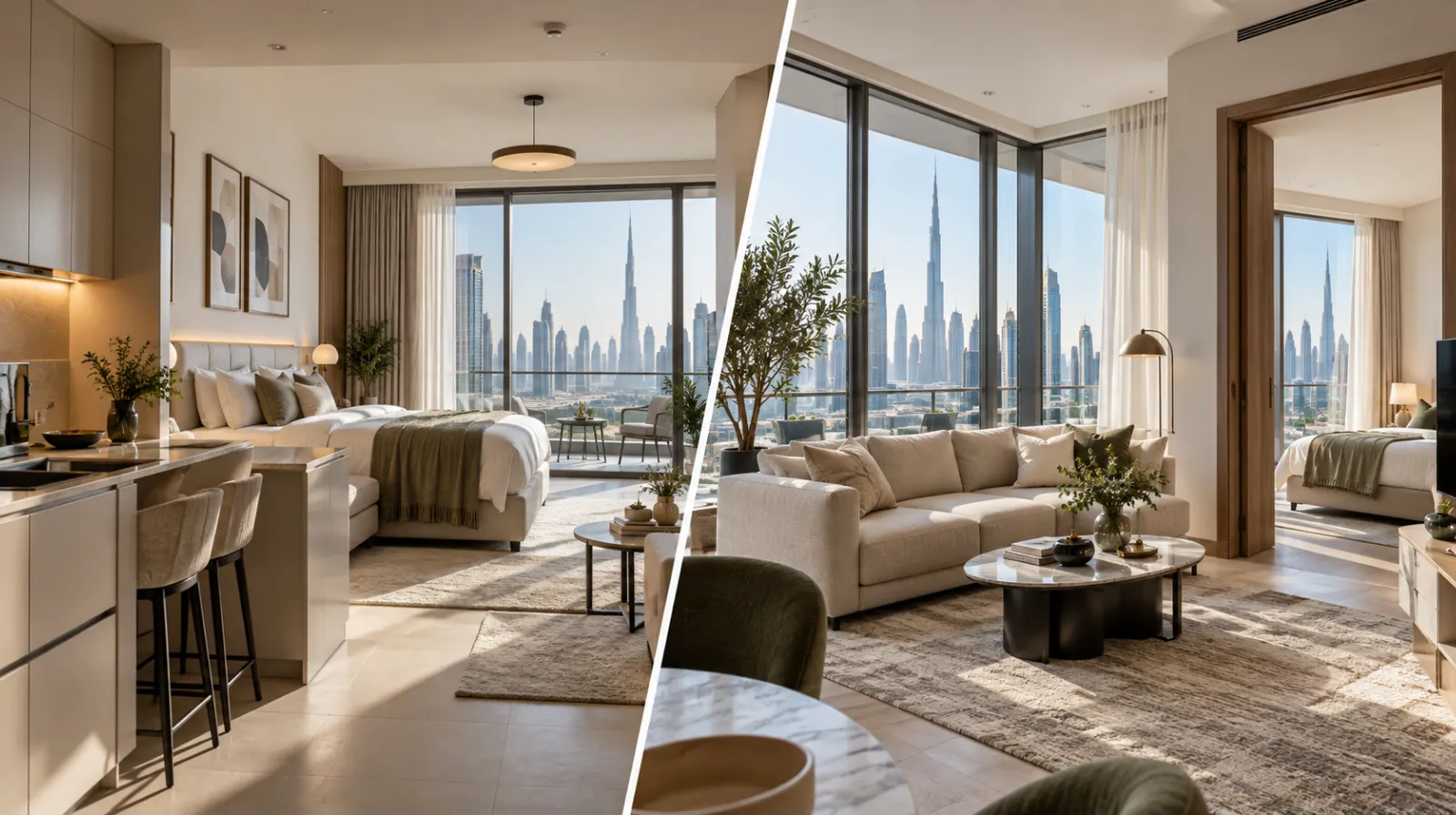
Studio vs 1-Bedroom Apartment Dubai Investment Guide
Oct 14, 2026

جزئیات وبلاگ
Compare Dubai vs Abu Dhabi property investment by ROI, rental yield, growth, costs, risks and top areas to choose the right UAE market in 2026.
مقاله
Dubai vs Abu Dhabi property investment is ultimately a comparison between two strong but structurally different UAE property markets. Dubai generally offers greater market depth, more project choice, stronger resale liquidity and broader short-term rental opportunities. Abu Dhabi, meanwhile, entered 2026 with particularly strong price growth, expanding foreign investment and competitive yields in several affordable and mid-market communities.
For investors, the better city depends on the objective. Rental income, capital appreciation, entry budget, holding period and preferred property type can all lead to a different answer.
Key Takeaways
The table below provides a practical overview. Yield ranges are based on selected popular residential areas reported during H1 2026 rather than a single citywide average.
| Factor | Dubai | Abu Dhabi |
| Indicative entry point in value apartment areas | Around AED 650k–700k for selected studios | Around AED 550k–700k for selected studios |
| Apartment rental yields | Roughly 5.5%–9% across selected popular areas | Roughly 3.5%–8.9% across selected popular areas |
| Villa rental yields | Roughly 4%–6.4% across selected areas | Roughly 4.3%–5.9% across selected areas |
| Capital appreciation | More selective in 2026; villas stronger than apartments in recent data | Strong current momentum across apartments and villas |
| Tenant demand | Very broad international and expatriate base | Deep long-term residential rental market |
| Short-term rental potential | Strong, especially tourism and business districts | More concentrated around leisure and premium islands |
| Resale liquidity | Generally stronger | Growing, but more area-dependent |
| Market risk | More cyclical and exposed to large supply pipelines | More concentrated, with significant off-plan activity |
| Best fit | Active investors, income seekers and buyers needing liquidity | Long-horizon investors and buyers seeking selective growth opportunities |
Dubai recorded AED 252 billion of real estate transactions during Q1 2026, with transaction value up 31% year on year. Abu Dhabi recorded AED 117 billion of total real estate transactions across H1 2026, an increase of 112% year on year, alongside rapid growth in international investment. The figures cover different reporting periods, so they should not be read as a direct volume comparison, but both demonstrate substantial market activity.
The city should not be the first decision. Your investment strategy should.
Before choosing between Dubai and Abu Dhabi, define five variables: what return you want, how much capital you can commit, how long you intend to hold, whether you need rental income immediately and how easily you may need to exit.
A few distinctions matter most:
The best investment may therefore be a Dubai apartment for one buyer and an Abu Dhabi villa for another.
Neither city consistently wins across every property segment.
The strongest affordable apartment areas in both emirates currently offer high gross yields. Dubai has more high-volume investment districts, while Abu Dhabi has several value-oriented locations where lower acquisition prices support particularly strong percentage returns.
| Example | Current Indicative Gross ROI |
| Dubai – JVC apartments | 7.15% |
| Dubai – Arjan apartments | 7.10% |
| Dubai – Dubai Marina apartments | 5.88% |
| Dubai – DAMAC Hills 2 villas | 5.97% |
| Abu Dhabi – Al Reef apartments | 8.92% |
| Abu Dhabi – Al Reem Island apartments | 6.34% |
| Abu Dhabi – Yas Island apartments | 5.94% |
| Abu Dhabi – Al Reef villas | 5.92% |
| Abu Dhabi – Al Raha Gardens villas | 5.91% |
These are area-level projected gross returns, not guaranteed investor returns. Individual building quality, service charges, purchase price, vacancy and financing can significantly change the net outcome.
Apartments are generally the easiest product for investors to compare because both cities have large tenant markets and relatively accessible entry prices.
Dubai offers considerable variety. In H1 2026, JVC recorded an indicative 7.15% ROI, Arjan 7.10%, Business Bay 6.29% and Dubai Marina 5.88%. More affordable districts such as Discovery Gardens exceeded 9% in the same dataset.
Abu Dhabi can compete directly on yield. Al Reef reached an indicative 8.92%, Masdar City 7.63% and Al Reem Island 6.34%. Yas Island and Al Maryah Island were both around 5.94% in the luxury segment.
For entry-level income investors, Abu Dhabi should therefore not be treated as the automatically lower-yield market. Dubai's advantage is more about the breadth and liquidity of available investment submarkets.
Villa yields are generally lower than affordable apartment yields because purchase prices are higher. However, family demand and limited land can support stronger long-term value.
In Dubai, H1 2026 indicative villa yields included approximately 5.97% in DAMAC Hills 2, 6.04% in Jumeirah Golf Estates and 6.37% in Al Barari.
In Abu Dhabi, Al Reef reached approximately 5.92%, Al Raha Gardens 5.91%, Yas Island 5.00% and Saadiyat Island 4.32%.
For villa investors, the better city depends less on headline yield and more on entry price, family demand, maintenance exposure and future competing supply.
The answer in 2026 looks different from the answer several years ago.
Dubai experienced an exceptional post-2020 growth cycle. By May 2026, citywide residential values were still 2.5% higher year on year, but the market was showing signs of stabilisation. Villa values remained 5% higher annually, while apartment values were 1.4% lower on the same index.
Abu Dhabi entered a much stronger acceleration phase. H1 2026 official data showed resale apartment prices up around 20% year on year and villa prices up 12%. Residential sales reached AED 70.4 billion, while investment-zone rents were also rising strongly.
This does not mean Abu Dhabi will automatically outperform in future. It means current cycle positioning differs.
Dubai growth drivers include its international investor base, tourism, deep resale market, infrastructure investment and global luxury demand. A record 296 homes above US$10 million changed hands during H1 2026.
Abu Dhabi growth is being supported by expanding investment zones, substantial institutional development, international capital and relatively constrained supply in selected premium districts. Eight new investment zones were approved during H1 2026, bringing the total to 50.
For appreciation-focused investors, Abu Dhabi currently deserves serious consideration. For liquidity and a longer-established international resale ecosystem, Dubai still has structural advantages.
Dubai should not be treated as one investment market. JVC and Al Barari, for example, serve completely different objectives.
JVC remains one of Dubai's most practical mid-market investment areas. H1 2026 data placed its apartment ROI at approximately 7.15%, with an average transaction value of around AED 1.08 million and average price near AED 1,470 per square foot.
Its appeal comes from the combination of moderate entry pricing, significant apartment inventory and a broad tenant base.
Best suited to: Investors seeking rental income without entering Dubai's premium price bracket.
The main risk is supply. JVC has substantial existing and future inventory, so individual building quality and purchase price matter greatly.
DAMAC Hills 2 provides a very different proposition: relatively accessible villas and townhouses.
H1 2026 data indicated an average transaction value of about AED 1.82 million and an indicative villa ROI close to 6%. Its lower price point compared with central villa communities gives investors access to family-oriented property without the entry cost of Dubai Hills Estate or Arabian Ranches.
Its trade-off is location. Tenant and buyer demand is more dependent on residents who accept a suburban commute.
Best suited to: Investors seeking relatively affordable villa exposure and family rental demand.
Al Barari belongs to the opposite end of the market.
Its ultra-luxury villas averaged more than AED 3,300 per square foot in H1 2026, with transaction values exceeding AED 23 million in the market sample. It also recorded an indicative villa ROI of around 6.37%, unusually strong for an ultra-luxury segment.
The investment thesis is less about affordability and more about scarcity, large homes, greenery and premium end-user demand.
Best suited to: High-net-worth investors prioritising capital preservation and appreciation rather than maximum liquidity.
Three additional areas cover different investor profiles:
| Area | Investment Angle | H1 2026 Indicative Apartment ROI |
| Dubai Marina | Established waterfront rental market and international demand | 5.88% |
| Business Bay | Central professional tenant base | 6.29% |
| Arjan | Lower entry price and yield-led strategy | 7.10% |
Abu Dhabi's strongest opportunities range from affordable yield-driven communities to premium islands where appreciation and end-user demand matter more than immediate return.
Al Reef is one of the clearest income-focused cases in Abu Dhabi.
Affordable apartments recorded an indicative 8.92% ROI in H1 2026. Average prices were approximately AED 690,000 for studios and AED 895,000 for one-bedroom units. Villas produced an indicative yield of around 5.92%.
That combination of lower acquisition cost and established residential demand makes Al Reef particularly relevant to first-time and yield-focused investors.
Best suited to: Investors prioritising cash flow and accessible entry pricing.
Hydra Village is a more specialised value proposition.
By July 2026, its residential sale-price index stood around AED 617 per square foot, approximately 19% higher than twelve months earlier. Rental values were also up, with average rent per square foot around AED 49. Current villa listing analytics indicated potentially high gross returns, although the market is smaller and less liquid than major island districts.
The lower entry price can be attractive, but investors should account for location, tenant depth and exit liquidity.
Best suited to: More yield-oriented investors comfortable with a smaller suburban market.
Al Raha Gardens provides a stronger family and stability proposition.
H1 2026 data showed an indicative villa ROI of around 5.91%, with average prices near AED 984 per square foot. Four-bedroom properties averaged roughly AED 3.27 million.
Current property indices also showed substantial year-on-year price growth through July 2026, reinforcing the area's appeal to family buyers.
This is less of a maximum-yield play and more of a combination of established family demand, rental stability and capital-growth potential.
| Area | Main Investor Angle | Indicative H1 2026 ROI |
| Al Reem Island | Established mid-market apartments and central connectivity | 6.34% |
| Yas Island | Luxury rental, leisure and end-user demand | 5.94% apartments |
| Saadiyat Island | Ultra-luxury and long-term capital positioning | 3.51% apartments / 4.32% villas |
Saadiyat's lower percentage yield should not automatically make it a weaker investment. Premium markets are often purchased for capital preservation, scarcity and appreciation rather than maximum annual income.
Purchase price is only one part of the investment.
| Cost | Dubai | Abu Dhabi |
| Sale registration | 4% total under current DLD schedule, shown as 2% seller + 2% buyer | Transaction-specific; current regulations set sale fees within an official range, while off-plan registration is 2% total |
| Brokerage | Contract/transaction dependent | 2% on sales, capped at AED 500,000 |
| Mortgage registration | 0.25% of mortgage value in Dubai | 0.1% of mortgage value under current fee schedule |
| Service charges | Building/community specific | Building/community specific |
| Trustee/registration partner | Applies to relevant Dubai transfers | Different registration structure |
| Maintenance | Property specific | Property specific |
Dubai's current completed-property registration schedule also includes an AED 250 title-deed fee and trustee/service-partner charges of AED 4,000 plus VAT for transactions of AED 500,000 or more.
Abu Dhabi's regulations set brokerage commission at 2% for property sales, up to AED 500,000. Off-plan sale registration is currently 2% of property value, divided equally between buyer and seller unless otherwise arranged. Other sale registration fees should be verified for the specific transaction because the regulatory framework allows variation within the prescribed range.
Financing rules are largely UAE-wide. For expatriates purchasing an investment or subsequent property, the regulatory maximum LTV is 60%, meaning at least 40% equity is generally required before additional acquisition costs. Off-plan mortgage LTV is capped at 50%. Banks may apply stricter limits.
Important: Fees, mortgage offers and developer incentives can change. Recalculate the full acquisition cost immediately before purchasing.
Both markets are regulated and mature enough to attract substantial international capital, but investors face different risks.
Dubai's main risks come from market cyclicality and supply. Large numbers of new apartments can put pressure on rents or resale values in specific submarkets. The market is also highly international, making some segments more sensitive to global investor sentiment.
Abu Dhabi's main risks include concentration. H1 2026 was heavily dominated by off-plan sales, which represented 89% of residential sales value. A smaller number of developers and projects also accounted for a large share of primary-market activity.
Liquidity also differs. Dubai's larger transaction base, broader foreign buyer audience and higher volume of active listings can make exit strategies easier in mainstream areas. Abu Dhabi liquidity is improving rapidly but remains more community-dependent.
Risk should therefore be evaluated at property level. An overpriced Dubai studio can be riskier than a well-bought Abu Dhabi apartment, regardless of which city has the larger market.
| Investor Profile | Better Starting Point | Why |
| First-time investor | Dubai or value Abu Dhabi areas | Both offer accessible apartments; Dubai has broader choice |
| High-yield investor | Compare both | JVC/Arjan in Dubai and Al Reef/Masdar in Abu Dhabi all offer competitive yields |
| Luxury investor | Dubai for liquidity; Abu Dhabi for selective growth | Dubai has deeper global luxury demand; Saadiyat and Yas provide premium Abu Dhabi exposure |
| Capital-growth investor | Abu Dhabi deserves stronger 2026 weighting | Current price momentum is stronger |
| Villa investor | Depends on budget | Dubai offers wider community choice; Abu Dhabi can offer lower entry points |
| Apartment investor | Dubai for market depth; Abu Dhabi for selected yield/growth | Both markets offer compelling options |
| Short-term rental investor | Dubai | Broader tourism and short-stay demand |
| Long-term family rental investor | Both | Dubai offers scale; Abu Dhabi has strong long-term leasing depth |
Abu Dhabi had around 233,000 active residential lease contracts in H1 2026, while Dubai recorded 1.38 million registered tenancy contracts during 2025. The datasets are not directly comparable, but both demonstrate deep rental demand.
There is no need to declare one city universally better.
Choose Dubai property investment if you value deeper resale liquidity, more project choice, international tenant demand and stronger short-term rental potential. It is also easier to diversify across very different strategies, from affordable yield apartments to ultra-prime villas.
Choose Abu Dhabi property investment if you are attracted by its current growth cycle, expanding foreign-investor access, strong long-term leasing market and high yields in selected affordable communities. H1 2026 data makes Abu Dhabi particularly difficult to overlook for growth-oriented investors.
Consider splitting your UAE property investment if you have sufficient capital and want different exposures. A yield-focused Dubai apartment can serve a different role from an appreciation-focused Abu Dhabi property.
The strongest strategy is ultimately not choosing the winning city. It is selecting the right unit, at the right price, in the right part of each market.
Both can produce strong rental returns. Dubai has more high-volume rental districts, but Abu Dhabi areas such as Al Reef and Masdar City currently offer yields that can match or exceed many Dubai communities.
Current 2026 data favours Abu Dhabi for recent percentage growth, with resale apartment and villa prices showing strong year-on-year increases. Dubai remains a deeper and more liquid market but is currently in a more selective phase.
Neither city is automatically safer. Dubai has greater liquidity but more supply and cyclicality. Abu Dhabi has strong current fundamentals but more concentrated off-plan activity. Property-level due diligence matters more than the city label.
Dubai offers a wider range across both categories. Abu Dhabi has competitive affordable and mid-market villas, while its apartment market currently combines strong rental yields with notable price growth.
It depends on area and property type. High-performing affordable apartment districts in both cities currently exceed 7% gross yield, with some selected communities approaching or exceeding 9%.
Dubai generally offers more project choice and a deeper resale market. Abu Dhabi can provide attractive lower-entry opportunities in communities such as Al Reef and Al Ghadeer. First-time buyers should compare total costs and exit liquidity rather than city reputation alone.
In Dubai, JVC, Arjan, Dubai Marina, Business Bay, DAMAC Hills 2 and selected premium areas such as Al Barari offer different investment profiles. In Abu Dhabi, Al Reef, Al Reem Island, Masdar City, Yas Island, Al Raha Gardens and Saadiyat Island cover income, family and luxury strategies.
Entry prices vary dramatically. Current value-area apartment examples start around the mid-AED 500,000s in Abu Dhabi and around the mid-AED 600,000s in several Dubai districts, while prime properties can cost tens of millions. Acquisition fees and financing must be added separately.
There is no reliable citywide answer. Service charges are project-specific and depend on amenities, building management and property type. Compare the actual annual charge before calculating net yield.
Both cities have major off-plan markets. Abu Dhabi's H1 2026 market was especially off-plan-led, with 89% of residential sales value coming from off-plan transactions. Off-plan can suit long-horizon buyers, but developer quality, escrow protection, payment terms and handover risk should be checked carefully.
آخرین وبلاگها
Oct 14, 2026
Oct 12, 2026
Oct 10, 2026
Sep 30, 2026

Sep 28, 2026