

Buying Property in Dubai: Pros and Cons
Nov 6, 2026
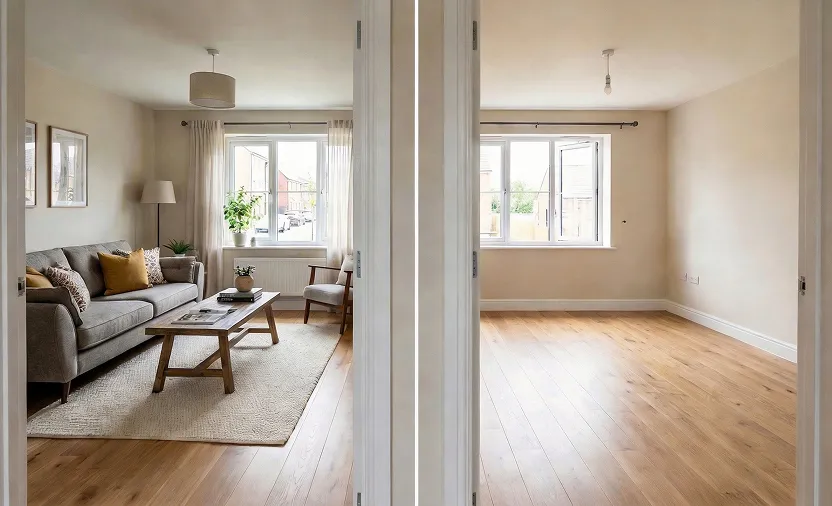
جزئیات وبلاگ
Furnished vs unfurnished property investment in Dubai: Compare rental yields, furnishing costs, tenant demand, and net ROI to find the better option.
مقاله
For furnished vs unfurnished property investment in Dubai, furnished homes can achieve higher rents and suit newcomers or short stays, while unfurnished homes can reduce setup costs and suit established, long-term tenants. The stronger investment depends on income retained after vacancy, management, maintenance, and furniture replacement. Will the additional rent justify the extra capital and work? Compare equivalent properties and lease strategies before deciding.
These are operating tendencies, not guaranteed outcomes. Furnishing alone does not determine vacancy, lease duration, or profitability.
| Factor | Furnished | Unfurnished |
| Upfront cost | Furniture and setup add capital | Lower setup requirement |
| Achievable rent | Potential convenience premium | Less scope for a furnishing premium |
| Tenant profile | New arrivals, corporate tenants, and residents seeking convenience | Established residents and families with furniture |
| Lease length | Annual or permitted short stays | Commonly annual |
| Vacancy | Sensitive to pricing and turnover | Sensitive to pricing and tenant retention |
| Maintenance | Property plus supplied contents | Property and any supplied appliances |
| Management effort | More inventory and replacement work | Fewer contents to manage |
| Wear and tear | Owner bears furniture aging | Less owner-owned furniture exposure |
| Resale flexibility | Turnkey appeal; removal may be needed | Buyers can furnish to taste |
| Net yield | Higher only if premiums cover costs | Can outperform despite lower rent |
Treat listing labels as a starting point and verify the actual inventory. Unfurnished generally means no movable household furniture, although fitted wardrobes and kitchen fixtures may remain. Semi-furnished can describe appliances, selected furniture, or both.
Fully furnished should specify beds, seating, dining furniture, and the agreed appliances and household items. A fitted kitchen does not necessarily include a refrigerator, washing machine, or every cooking appliance.
Serviced or hotel apartments involve separate operating arrangements. Furniture alone does not create that status, and DET excludes hotel and hotel-apartment buildings from its Holiday Homes permit route. Because listing descriptions vary, attach an itemized inventory and condition photographs to the tenancy agreement.
The cost of furnishing an apartment in Dubai depends on its size, layout, furniture quality, existing appliances, and the supplier's package specifications. Publicly advertised supplier prices provide useful starting points, but package prices should not be confused with the total cost of preparing a property for occupancy.
The following prices were checked directly against the suppliers' published websites on November 6, 2026.
| Supplier and package | Studio | 1-bedroom | 2-bedroom | VAT and scope |
| Mov'in — Starting Packages | AED 9,581 | AED 10,777 | AED 15,146 | VAT inclusion not clearly stated on the referenced page; installation is an additional service |
| Aziza Home — Essential | From AED 26,000 | From AED 34,500 | From AED 46,000 | Excludes VAT and appliances |
| Aziza Home — Premium | From AED 30,500 | From AED 42,000 | From AED 63,500 | Excludes VAT and appliances |
| Aziza Home — Luxury | From AED 52,500 | From AED 76,000 | From AED 98,500 | Excludes VAT and appliances |
Mov'in offers customizable furnishing packages and lists installation and post-installation cleaning as additional services. Its advertised starting prices should not be treated as confirmed all-inclusive quotations.
Aziza Home explicitly excludes VAT and appliances from its published package prices. Its packages also vary in decorative and interior-design scope. The suppliers' advertised prices therefore represent different specifications and should not be compared as identical turnkey products.
For preliminary investment planning, Homeland uses the following editorial budget ranges, informed by publicly available supplier prices and estimated additional setup costs. These are Homeland editorial estimates, not published supplier quotations, verified market averages, or guaranteed project prices.
| Apartment | Economy | Mid-range | Premium |
| Studio | AED 18,000–25,000 | AED 30,000–45,000 | AED 65,000–90,000+ |
| One-bedroom | AED 22,000–32,000 | AED 40,000–60,000 | AED 90,000–125,000+ |
| Two-bedroom | AED 30,000–45,000 | AED 55,000–80,000 | AED 120,000–160,000+ |
The planning allowances aim to account for furniture, essential appliances, curtains, basic linen, kitchenware, delivery, installation, and applicable VAT. They exclude renovations and bespoke joinery. Actual costs may exceed these ranges, especially where an individual supplier's package price already approaches the budget limit before appliances and tax. Check whether the supplier’s quotation includes or excludes 5% VAT, delivery, installation and appliance costs. Request an itemized quotation before committing capital. Deduct any appliances already supplied by the developer, and obtain separate quotations for requirements specific to Holiday Homes.
Furniture costs continue beyond the initial purchase. For preliminary financial modeling, an investor may reserve approximately 10% of the initial furnishing expenditure annually for replacements and repairs. This is a Homeland budgeting assumption, not an established market benchmark or a mandatory annual expense. Review linens and kitchenware after tenant turnover. Assess upholstery, mattresses, furniture, and appliances individually based on condition, usage, and warranty coverage.
Compare furnished and unfurnished apartments using properties with similar layouts, floor areas, building quality, views, parking arrangements, and payment terms. Separate advertised rents from completed tenancy contracts, and annual lease rates from monthly or nightly advertisements. The key question is not how much additional rent a furnished property advertises, but how much extra income it retains after operating costs. Calculate the difference in collected annual rent after vacancy, then deduct any additional management, cleaning, maintenance, utility, and furniture replacement costs.
A simplified furnishing payback calculation is: "Furniture payback period = Initial furnishing cost ÷ Additional annual net rental income". This calculation is meaningful only when the additional annual net income is positive.
Dubai's official rental index does not distinguish between furnished and unfurnished residential units when assessing rental values for rent-increase purposes. The Dubai Land Department confirms this in its official Campaign for Ejari Services FAQ. Furniture may influence the rent agreed between a landlord and a new tenant, depending on the property and prevailing market conditions.
However, furnishing a property does not automatically entitle the landlord to increase an existing tenant's rent beyond the applicable regulatory limits.
At tenancy renewal, permitted increases remain subject to Dubai's rental legislation and the applicable official rental index. Investors should therefore distinguish between a potential furnishing premium in a newly negotiated lease and a legally permitted rent increase during an existing tenancy relationship.
A furnished apartment does not automatically qualify as a Holiday Home. An owner can lease a fully furnished apartment under a standard annual tenancy agreement without operating it as tourist accommodation. Short-term Holiday Home operations are subject to a separate regulatory framework.
According to Dubai's Department of Economy and Tourism (DET), apartments and villas must be registered and approved before being listed as Holiday Homes.
A Holiday Home investment requires a separate revenue and expense model, rather than applying annual rental assumptions to nightly accommodation.
Revenue should be estimated using: "Average nightly rate × Occupied nights". Investors should account for monthly seasonality, actual occupancy, and the following additional costs:
| Cost category | Holiday Home consideration |
| DET permit | Unit registration, classification and applicable permit fees |
| Utilities | Electricity, water, internet, cooling, and other owner-paid services |
| Management | Operator fees, booking administration, and guest coordination |
| Cleaning | Turnover cleaning, laundry, and consumables not recovered from guests |
| Platform fees | Booking-platform commissions and payment processing |
| Maintenance | Additional repairs and furniture replacement associated with guest turnover |
| Tourism Dirham | Applicable guest levy, collected and remitted under DET rules |
| Insurance | Coverage appropriate to the intended short-term rental activity |
DET's Holiday Homes guide specifies a Tourism Dirham of AED 10 per room per night for Standard Holiday Homes and AED 15 for Deluxe Holiday Homes, subject to the applicable collection rules.
Tourism Dirham collected from guests should be accounted for separately from retained rental income and remitted as required. None of these Holiday Home-specific assumptions are included in the annual tenancy ROI example below.
Consider the same hypothetical one-bedroom apartment under two annual lease strategies. The calculations below are illustrative November 2026 assumptions, not actual property performance, a valuation, or a rental forecast. The example assumes a cash purchase of AED 1,000,000, an existing residential apartment, and a buyer who bears the agreed transaction fees.
Dubai property acquisition costs depend on the transaction structure, financing arrangements, and services used. The previous AED 70,000 acquisition allowance is replaced here with an itemized transaction-cost example.
| Acquisition cost | Illustrative amount | Application |
| DLD registration fee | AED 40,000 | 4% of purchase price; the example assumes the buyer agrees to bear the full amount |
| Real Estate Registration Trustee fee | AED 4,200 | AED 4,000 plus 5% VAT for this property value |
| Agency commission | AED 21,000 | If applicable; illustrative 2% commission plus 5% VAT on the commission |
| Title deed issuance | AED 250 | Published DLD fee |
| Apartment map fee | AED 250 | Published DLD fee |
| Knowledge and innovation fees | AED 20 | Based on one applicable AED 10 charge of each type |
| Illustrative acquisition costs | AED 65,720 | For the stated transaction assumptions |
The DLD schedule identifies a 2% seller share and a 2% buyer share of the registration fee. The example assumes that the buyer agrees to cover the full 4%, as may occur in a negotiated transaction. Agency commission is negotiable and is not a fixed government charge. The 2% figure is used only as an illustrative brokerage assumption. Additional costs may arise depending on the transaction:
These additional variable fees are excluded from the example because their amounts cannot be established without a specific transaction.
Both scenarios assume that tenants pay their own utilities. Financing costs, capital appreciation, future disposal costs, and owner-specific taxes are excluded.
| Item | Unfurnished | Furnished |
| Purchase price | AED 1,000,000 | AED 1,000,000 |
| Itemized acquisition costs | AED 65,720 | AED 65,720 |
| Furnishing and setup | AED 0 | AED 40,000 |
| Total invested | AED 1,065,720 | AED 1,105,720 |
| Annual advertised rent | AED 80,000 | AED 95,000 |
| Vacancy allowance | 3%: AED 2,400 | 5%: AED 4,750 |
| Rent collected | AED 77,600 | AED 90,250 |
| Service charges | AED 12,000 | AED 12,000 |
| Maintenance and turnover cleaning | AED 2,000 | AED 3,000 |
| Management: 5% of collected rent | AED 3,880 | AED 4,512.50 |
| Annual furniture reserve | AED 0 | AED 4,000 |
| Owner insurance | AED 500 | AED 800 |
| Net annual income after reserve | AED 59,220 | AED 65,937.50 |
| Advertised gross yield on purchase price | 8.00% | 9.50% |
| Net rental yield on total invested | 5.56% | 5.96% |
The management allowance is assumed to include any applicable VAT on the management service. No separate owner-paid leasing commission is assumed; add one if payable. Service charges must be verified for the specific building using the approved DLD Service Charge Index. The calculation uses: "Net rental yield = Annual income after operating costs and replacement reserve ÷ Total invested × 100:"
Here, an assumed 18.75% advertised rent premium produces only approximately 0.41 percentage points of additional net rental yield. If furnished annual rent falls to AED 90,000, with the same vacancy rate and other assumptions unchanged, its net rental yield drops to approximately 5.56%, nearly identical to the unfurnished scenario.
The model demonstrates the sensitivity of furnished rental returns to achievable rent, vacancy, and furniture expenditure. It measures net annual rental yield, not total investment ROI or an investor's leveraged cash-on-cash return.
Different parts of Dubai attract different renter profiles, but a neighborhood's popularity does not prove that furnished apartments deliver higher returns there.
According to Bayut's H1 2026 Dubai Rental Market Report, average advertised annual rents for one-bedroom apartments were:
| Area | Average annual asking rent | Data type |
| Jumeirah Village Circle (JVC) | AED 79,000 | Portal asking rent |
| Business Bay | AED 104,000 | Portal asking rent |
Methodology: Bayut's average advertised rental prices by area and bedroom category. The report separately presents Dubai Land Department transaction-rent averages at an area level.
Furnished/unfurnished breakdown: The cited one-bedroom asking-rent figures are not separately categorized by furnishing status in the published report.
These are asking rents, not contracted rents, and they do not establish the additional rent attributable to furniture.
Bayut's report also identifies Dubai Marina and Downtown Dubai among popular luxury apartment locations, with JVC, Business Bay, and Arjan among prominent mid-tier rental destinations.
These classifications and popularity observations reflect Bayut's portal analysis and search trends, rather than a comprehensive measure of completed lease demand across Dubai.
The following are practical investment hypotheses that should be tested using building-level rental comparables:
For an unfurnished apartment investment, prioritize achievable annual rent and tenant retention within the individual building rather than relying on area averages.
Record furniture condition, appliance serial numbers, warranties, and replacement values before occupancy. Use signed check-in and check-out inventories, photographs, and maintenance records to reduce disagreements about property condition.
Security deposits are generally collected to cover eligible damage or maintenance-related obligations at the end of a tenancy. In Dubai, deposits of around 5% of annual rent for unfurnished properties and 10% for furnished properties are commonly encountered market practices.
These percentages are not statutory maximum deposit limits. The deposit amount should be agreed and specified in the tenancy contract. Article 20 of Dubai Law No. 26 of 2007 allows landlords to obtain a security deposit and requires the landlord to refund the deposit, or its remaining balance, upon expiry of the tenancy. Article 21 also recognizes ordinary wear and tear when assessing the condition in which the property is returned. A refundable security deposit should not be treated as rental income or as a substitute for an adequately funded maintenance reserve.
Separate accidental damage from ordinary aging and deterioration. Request property-management proposals that clearly identify the management fee base, VAT treatment, renewal charges, maintenance markups, inspections, cleaning, and emergency-callout costs. Confirm that insurance covers the intended rental activity and the supplied furniture or appliances.
For planning, investors may test three-to-five-year soft-furnishing and five-to-eight-year appliance replacement scenarios, adjusting them to actual usage, warranties, maintenance history, and condition. These replacement periods are illustrative modeling scenarios rather than mandatory schedules.
Do not assume that furnishing expenditure will be recovered in full when selling. Buyers may discount used furniture because of its condition, personal preferences, or potential removal costs.
Evaluate the real estate and contents separately when considering resale offers. A ready-to-rent property may appeal to investors seeking a faster rental launch, while owner-occupiers may prefer an unfurnished apartment they can personalize.
Branded or managed residences require separate analysis of operating agreements, service charges, and potential refurbishment obligations. Their price premiums cannot be attributed to furniture alone. Keep an accurate inventory and allow for furniture removal if a future buyer prefers an empty property.
For off-plan purchases, review the developer's furnishing schedule, appliance specifications, material quality, warranty terms, and substitution rights.
Confirm whether the quoted purchase price genuinely includes the furniture package or incorporates its cost into the overall property price.
Compare the total furnished purchase price against an equivalent unfurnished unit plus independent setup quotations.
Establish when appliance warranties begin and who is responsible for defects, delivery delays, or installation.
Allow sufficient time after handover for snagging, utility activation, furniture installation, photography, marketing, and any required approvals.
A furnished handover does not guarantee immediate rental income.
Choose an ownership strategy that matches your income expectations, operational capacity, and intended holding period.
| Your goal | Starting point | What to verify |
| Passive investor | Unfurnished annual lease | Maintenance oversight and tenant retention |
| Short-term rental operator | Fully furnished | DET approvals, seasonality, and operating margin |
| Long-term landlord | Unfurnished or selectively furnished | Tenant demand and achievable net premium |
| Overseas owner | Either, with accountable management | Inventory reporting, fees, and repair authority |
| End-user | Personal furnishing preference | Move-in cost and future rental flexibility |
There is no reliable universal percentage. Compare similar properties within the same building and distinguish furniture value from utilities, views, renovations, and flexible payment terms. Asking-rent differences alone do not establish a furnishing premium.
Homeland's November 2026 editorial planning allowances range from approximately AED 22,000–32,000 for an economy setup to AED 90,000–125,000+ for premium specifications. These estimates are not supplier quotations. Check the latest package prices, VAT treatment, appliances, installation, and delivery before setting a final budget.
Only when additional collected rent compensates for higher costs and invested capital. In the illustrative annual tenancy example, net rental yields are 5.96% for furnished and 5.56% for unfurnished properties. Actual returns depend on the specific property and transaction.
Yes. Furnishing and rental duration are separate decisions. A furnished apartment can be rented under a standard annual tenancy agreement. Specify the furniture inventory, utility arrangements, maintenance responsibilities, and contractual terms.
No. The Dubai Land Department confirms that the rental index does not distinguish furnished from unfurnished residential properties for rental valuation purposes. Furnishing may influence a newly negotiated lease, but it does not exempt an existing tenancy from applicable rent-increase rules.
No. Holiday Home operations require DET registration and approval before listing. Building restrictions, ownership documentation, and contractual conditions can affect eligibility. Confirm these requirements before investing in a short-term rental strategy.
No. A 10% deposit for furnished accommodation and a 5% deposit for unfurnished accommodation are common market practices, not statutory limits. The agreed amount should be stated in the tenancy contract, and the landlord must return the deposit or its remaining balance in accordance with the applicable tenancy law.
Replacement should depend on actual condition and usage rather than a single fixed deadline. Inspect high-turnover items regularly and maintain a reserve for larger replacement costs.
It may improve presentation and convenience, but buyers may assign limited value to used furnishings. Do not assume furniture expenditure will translate into an equivalent increase in the property's resale value.
آخرین وبلاگها
Nov 6, 2026
Nov 6, 2026
Nov 1, 2026
Oct 14, 2026