
Area Details
Dubai South
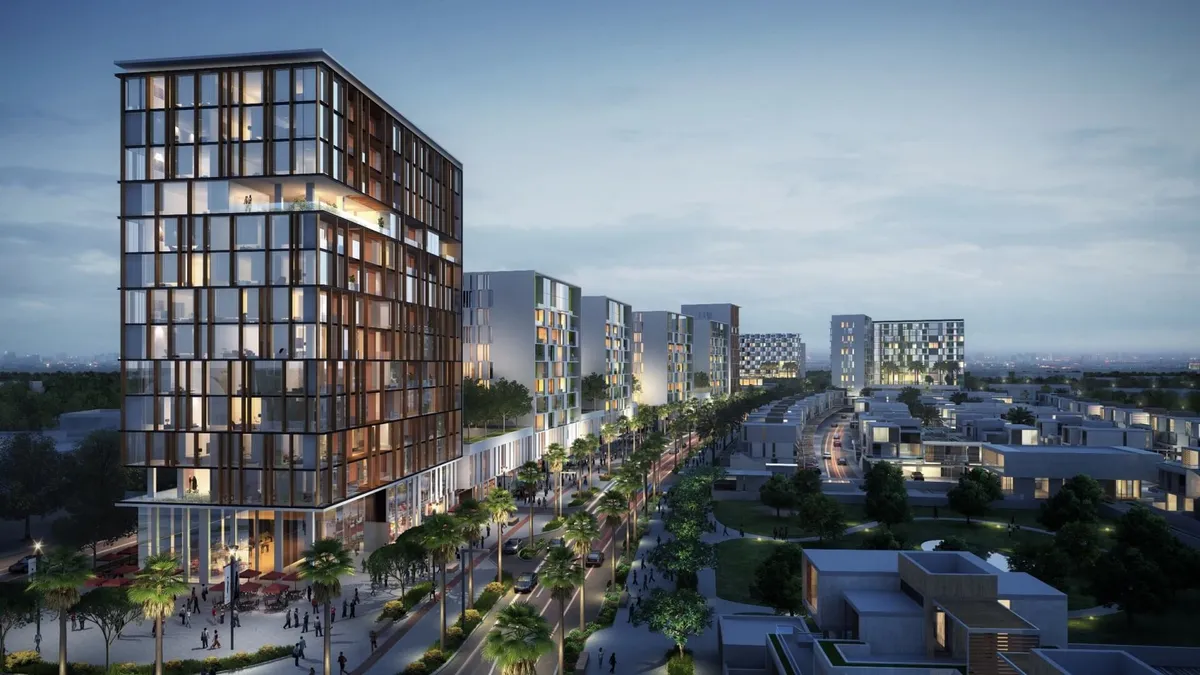
Dubai South is one of Dubai’s large, master-planned districts in the southern part of the city, combining residential living, urban infrastructure, access to major transport corridors, and the phased development of everyday amenities. This guide focuses on the residential section of Dubai South. As a result, the market figures and observations in this article apply only to this specific scope and should not be generalized to all subdistricts of Dubai South or to Emaar South. For buyers and investors, Dubai South is most relevant when the objective is to enter an area that is still developing, with newer projects, a comparable entry price point, and access to southern Dubai. In contrast, buyers who need a fully established urban environment, a wider range of existing services, or faster daily access to central Dubai should compare this area with several other options before making a decision.
Dubai South
Dubai South is one of Dubai’s large, master-planned districts in the southern part of the city, combining residential living, urban infrastructure, access to major transport corridors, and the phased development of everyday amenities. This guide focuses on the residential section of Dubai South. As a result, the market figures and observations in this article apply only to this specific scope and should not be generalized to all subdistricts of Dubai South or to Emaar South. For buyers and investors, Dubai South is most relevant when the objective is to enter an area that is still developing, with newer projects, a comparable entry price point, and access to southern Dubai. In contrast, buyers who need a fully established urban environment, a wider range of existing services, or faster daily access to central Dubai should compare this area with several other options before making a decision.
Snapshot
Short Overview
Dubai South is one of Dubai’s large, master-planned districts in the southern part of the city, combining residential living, urban infrastructure, access to major transport corridors, and the phased development of everyday amenities. This guide focuses on the residential section of Dubai South. As a result, the market figures and observations in this article apply only to this specific scope and should not be generalized to all subdistricts of Dubai South or to Emaar South.
For buyers and investors, Dubai South is most relevant when the objective is to enter an area that is still developing, with newer projects, a comparable entry price point, and access to southern Dubai. In contrast, buyers who need a fully established urban environment, a wider range of existing services, or faster daily access to central Dubai should compare this area with several other options before making a decision.
Full Guide
About Dubai South
Overall Area Identity
Dubai South is not a traditional, long-established residential district. It is part of a larger urban development where residential, transport, aviation, logistics, and civic-service uses are gradually taking shape alongside each other. This makes it important to assess the area through a balanced lens: on one side, newer projects and a significant supply base; on the other, the need to review completion timelines, project quality, current service levels, and distance from key parts of the city.
Within the residential section, transaction data shows that apartments play a more prominent role in the overall market picture. Villas are also visible in secondary-market transactions, but the primary-market villa sample was not sufficient for displaying a full public villa pricing table. For that reason, the public pricing table in this guide is limited to apartments.
Location and Access
Dubai South is located in southern Dubai. From a location perspective, it is especially relevant for buyers who are focused on the city’s southern corridors, Al Maktoum International Airport, and the Expo area. Connection to Expo Metro Station via a public bus route, together with proximity to transport infrastructure in southern Dubai, is one of the points residents and investors may consider.
That said, any decision to live in or buy property in Dubai South should be assessed against real daily travel patterns. Proximity to southern Dubai is an advantage for some buyers, but for those commuting regularly to central Dubai, Dubai Marina, the financial district, or coastal areas, travel time and car dependency should be reviewed more carefully.
Lifestyle and Everyday Amenities
The lifestyle in the residential section of Dubai South is mostly based on living in a newer, planned, and still-developing environment. Amenities such as public parks, sports courts, everyday retail outlets, a hypermarket, a mosque, a petrol station, and bus connectivity to the metro have been reported for this area. The presence of educational services and developing retail destinations also gradually strengthens the area’s relevance for families.
This level of amenities may be suitable for buyers who are comfortable with Dubai’s newer districts. However, it is important to note that the daily experience in Dubai South may differ from more mature parts of the city. Established districts usually offer a broader variety of restaurants, local services, shopping centres, and leisure options. Therefore, comparing the lifestyle experience before buying is an important part of the decision.
Property Profile and Asset Types
The real estate market in this area, based on the available data, is largely focused on apartments. Studio, one-bedroom, two-bedroom, and three-bedroom apartments had sufficient publicly available data in both the primary and secondary markets. For villas, secondary-market transactions are more visible than those in the primary market.
This market composition conveys two different messages for end-users and investors. For apartments, it is easier to make a clear comparison between the primary and secondary markets. For villas, the decision should be more project-specific and case-by-case, rather than relying solely on a general benchmark rate.
Secondary-Market Benchmark
In this guide, the benchmark refers to the median secondary-market transaction price in AED per square foot. This figure is a starting point for comparison, not a definitive price for every project or every unit.
| Property type | Secondary-market benchmark |
| Apartment | AED 1,094 per sq ft |
| Villa | AED 1,277 per sq ft |
The correct way to read this table is to assess apartments and villas separately. A direct comparison between the two property types can be misleading if it does not account for size, project quality, internal location, handover status, service charges, and the level of rental demand.
Public Pricing Table for Apartments
| Property type | Median size | Median secondary-market price | Median secondary-market rate | Median primary-market price | Median primary-market rate |
| Apartment | 816 sq ft | AED 730,000 | AED 1,094 per sq ft | AED 1,224,636 | AED 1,448 per sq ft |
| Studio | 405 sq ft | AED 504,500 | AED 1,199 per sq ft | AED 612,000 | AED 1,558 per sq ft |
| One-bedroom | 781 sq ft | AED 737,500 | AED 1,065 per sq ft | AED 1,128,828 | AED 1,475 per sq ft |
| Two-bedroom | 1,135 sq ft | AED 1,155,000 | AED 1,035 per sq ft | AED 1,618,828 | AED 1,406 per sq ft |
| Three-bedroom | 1,510 sq ft | AED 2,000,000 | AED 1,073 per sq ft | AED 2,259,828 | AED 1,454 per sq ft |
The difference between primary and secondary-market figures should be interpreted with caution. Primary-market properties may include newer projects, payment plans, different handover timelines, and different contractual terms. The secondary market, by contrast, provides a more transaction-based view of ready units or units already circulating in the market. A sound decision is formed when these figures are compared against the project, developer, actual unit size, floor, view, tenancy status, and service charges.
Residential Supply and Under-Construction Properties
In the residential section of Dubai South, 6,907 completed residential units and 10,073 under-construction units are recorded. Of these, 5,553 completed units and 8,893 under-construction units are apartments. In the villa segment, 1,354 completed units and 1,180 under-construction units are recorded.
This composition shows that a significant part of the future inventory is still under construction. For buyers, this increases the ability to compare newer projects, but it also makes execution risk more important. Handover timing, developer track record, construction quality, registration status, payment plan, and future supply competition should be reviewed alongside the entry price.
Residential Occupancy Rate
The latest usable residential occupancy rate for this area was 92.9% in H2 2025. This figure may indicate active use of the residential inventory, but it should not be used on its own to draw conclusions about yield, price growth, or investment suitability.
To interpret occupancy properly, the unit type, project quality, rental appeal of comparable units, service charges, furnished or unfurnished status, and the owner’s objective should all be reviewed. Occupancy is a supporting indicator, not a substitute for unit-level analysis.
Who Should Consider Dubai South?
Dubai South may be worth considering for buyers looking for a newer district focused on residential projects and access to southern Dubai. End-user buyers may value the planned environment, newer projects, amenities that are still developing, and distance from the density of more central districts.
For investors, the area becomes more relevant when budget, holding period, handover timing, liquidity, and future supply competition are assessed together. In this type of district, choosing the right project and unit is usually more important than relying only on the area name.
Advantages and Considerations
Advantages
- Apartment transaction data is more reliable for general comparison.
- A secondary-market benchmark could be calculated for both apartments and villas.
- The residential occupancy rate was recorded at a high level in the latest available period.
- A significant volume of under-construction properties creates room to compare newer projects.
- Proximity to southern Dubai infrastructure and the Expo area can be a practical advantage for some buyers and tenants.
Considerations
- This guide focuses only on the residential section of Dubai South and does not cover all Dubai South subdistricts.
- Office data was not usable for general analysis within this scope.
- The public villa pricing table has been excluded because the primary-market sample was not sufficient.
- The large volume of under-construction properties makes handover timing and project execution quality more important.
- The final decision should be project-led and unit-led, not based only on the area name.
Homeland Advisory View
From Homeland’s perspective, Dubai South is most relevant for decision-makers who want to balance entry price, newer projects, access to southern Dubai, and the area’s urban-development outlook. The strongest data point in this analysis is the apartment segment, so pricing analysis and general comparison should begin with apartments.
For villas, the secondary-market benchmark is visible, but a more complete comparison requires a case-by-case review of each project and each unit. In both cases, the final decision should be based on budget, purchase objective, building quality, tenancy status, service charges, handover timing, payment terms, and comparable options in other areas.
Frequently Asked Questions
Is buying property in Dubai South suitable for every buyer?
No. Dubai South may be suitable for certain scenarios, especially when the buyer is aligned with the location in southern Dubai, newer districts, and the phased completion of amenities. For buyers who need fast access to central Dubai or a fully established urban setting, comparison with several other areas is essential.
How should the secondary-market benchmark in Dubai South be interpreted?
The benchmark is the median secondary-market transaction price. It is a starting point for comparison and does not replace reviewing the project, unit, floor, view, tenancy status, service charges, and building quality.
What type of buyer or investor should consider Dubai South?
This area may be worth considering for buyers focused on newer apartments, projects under development, access to southern Dubai, and a comparable entry price point. For investors, project selection, handover timing, and the exit scenario are especially important.
What should be reviewed before making a decision about Dubai South?
Handover timing, developer track record, registration status, execution quality, service charges, distance to work or school, rental appeal, and comparison with similar areas should all be reviewed.
Was office data used in this guide?
No. Within the selected scope, office data for transactions, supply, and occupancy was not reliable enough for use. Therefore, the office segment has not been included in the public analysis.
Are villas in Dubai South covered in this guide?
Villas are covered through the secondary-market benchmark. For villas, a project-specific and unit-specific review is more important.
To assess whether Dubai South aligns with your budget, purchase objective, and decision timeline, you can request an initial review from Homeland so that suitable options can be compared based on project, size, handover timing, and payment terms.