

Best Off-Plan Projects in Dubai With 2027 Handover
Sep 28, 2026
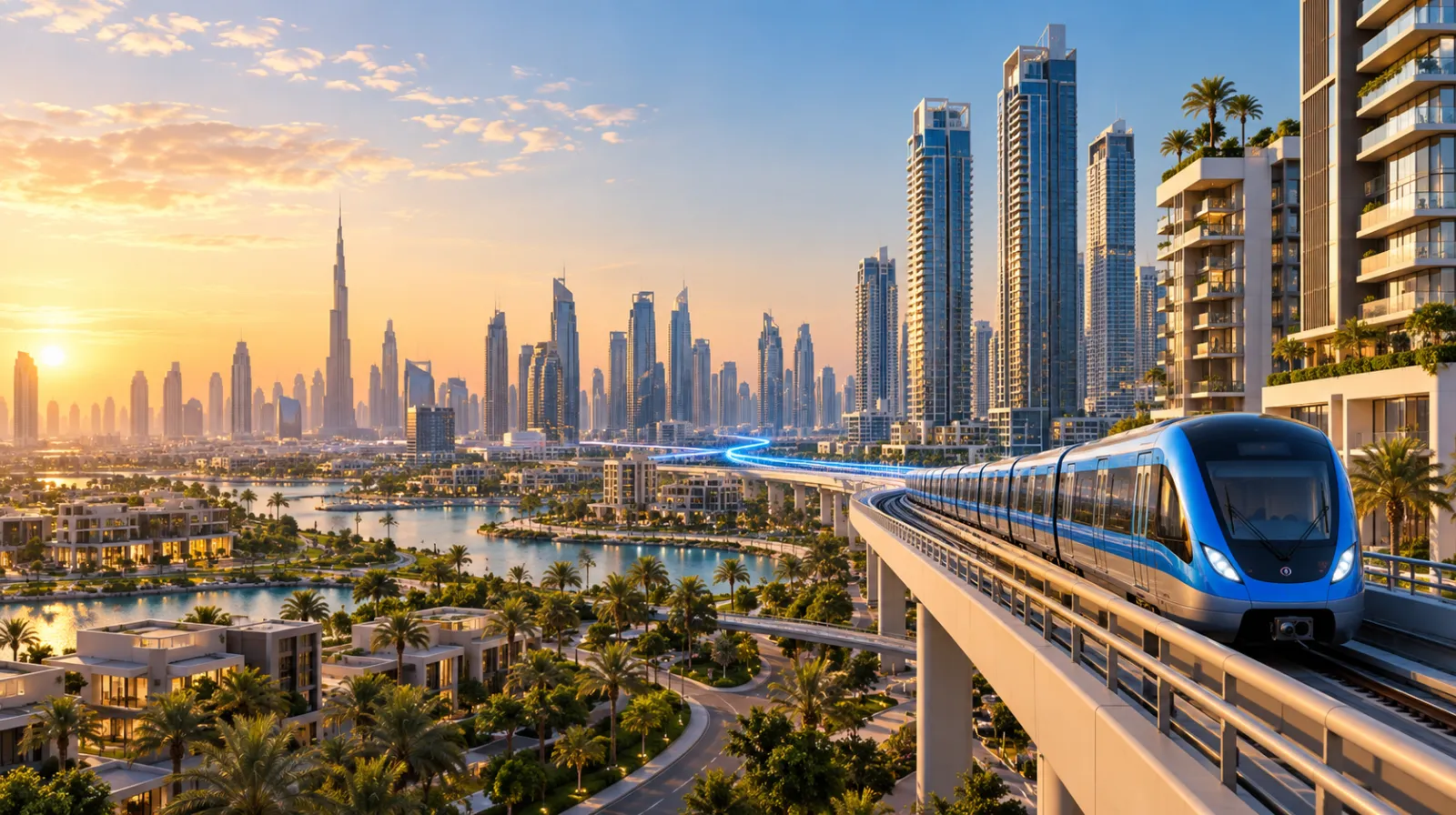
Blog Detail
A practical guide to Dubai Metro Blue Line property investment, including verified facts, area selection, off-plan caution, ownership basics, and buyer risk checks.
Article
Dubai Metro Blue Line matters to property buyers because future rail access can improve convenience, widen tenant demand, and raise area visibility, but smart decisions depend on separating confirmed facts from marketing noise; before you buy, you should verify route, station, and delivery details against the latest official announcement, avoid assuming guaranteed price growth, and ask a simple question: is the property attractive today, or only attractive if the line arrives exactly as hoped? Educational content; verify current rules with official sources.
Key Takeaways
According to an official RTA update published on 3 May 2026, the Dubai Metro Blue Line route and delivery schedule are now publicly confirmed. The 30-kilometre line will include 14 stations, including three interchange stations, with 15.5 kilometres underground and 14.5 kilometres above ground. It will connect with the Green Line at Creek Station and the Red Line at Centrepoint Station, serving areas including Dubai Festival City, Dubai Creek Harbour, Ras Al Khor, International City, Dubai Silicon Oasis, Dubai Academic City, Mirdif and Al Warqa’a. RTA reported that construction had reached 20% completion, with operations scheduled to begin on 9 September 2029. As this is an ongoing infrastructure project, buyers should continue checking RTA updates before making location-based investment decisions.
| Item | Status |
| Route length | 30 km in total, comprising 15.5 km underground and 14.5 km elevated. |
| Station count | 14 stations, including three interchange stations. RTA’s May 2026 update describes the remaining stations as seven elevated and four underground stations. |
| Interchange points | Creek Station on the Green Line, Centrepoint Station on the Red Line, and Dubai International City 1, which serves as the interchange between the Blue Line’s two routes. |
| Communities served | The Blue Line serves nine key districts, including Al Jaddaf, Dubai Festival City, Dubai Creek Harbour, Ras Al Khor, International City, Dubai Silicon Oasis, Dubai Academic City, Mirdif and Al Warqa. |
| Construction status | Under construction. Primary tunnelling works were launched on 3 May 2026, when RTA reported that the project had reached 20% completion. RTA expects overall progress to reach 30% by the end of 2026. |
| Official target opening | 9 September 2029 (09/09/2029). RTA continues to state that the project is scheduled to enter operation on this date. |
Route and project data checked on 2026-09-26.
| Confirmed station or area detail | What can be stated here |
| Blue Line station list | RTA officially confirms 14 stations. Publicly identified stations or station locations include Creek, Centrepoint, Dubai International City 1, Dubai International City 2, Dubai International City 3, Dubai Festival City, Dubai Creek Harbour, Ras Al Khor, Dubai Silicon Oasis, Dubai Academic City, Mirdif and Al Warqa. The Dubai Creek Harbour station has officially been named the Emaar Properties Station. Final public-facing names for every one of the 14 stations have not yet been published by RTA as a single definitive station-name list. |
| Blue Line area coverage | The 21-km route starts at Creek Station in Al Jaddaf, passes through Dubai Festival City, Dubai Creek Harbour and Ras Al Khor, reaches Dubai International City 1, and continues through International City 2 and 3, Dubai Silicon Oasis and Dubai Academic City. The 9-km second route starts at Centrepoint Station in Al Rashidiya, passes through Mirdif and Al Warqa, and connects to Dubai International City |
| Blue Line completion date | The Blue Line is officially scheduled to open and commence operations on 9 September 2029. RTA’s current programme targets 30% construction completion by the end of 2026, with the overall project remaining on schedule for the 2029 opening. |
Area-level analysis only works when the route itself is confirmed. Because the validated official source pack does not include an official Blue Line route or station page, this article does not label any community as officially confirmed. That matters for investors because distance claims, launch pricing, and so-called metro-linked marketing often move faster than verified infrastructure information.
New metro access can affect property demand, but the effect is uneven and highly local. Buyers often focus on the station headline, while tenants and end-users care about the full daily experience: how long the walk is, whether roads are easy to cross, whether retail and services improve, and whether the property type matches local demand.
Here are the main mechanisms:
It is also important to separate historical context from Blue Line forecasts. Existing metro corridors in Dubai show that transport access can matter, but that is not the same as proof that every future Blue Line property will rise in value. In some launches, the expected metro benefit may already be priced in before the line is operational.
Property type matters as much as location. A future station may support different kinds of demand in different areas, so the right product depends on who is likely to live there and why.
| Property type | Likely demand profile | What to check carefully |
| Studios | Single professionals, budget-driven tenants, and some short-stay demand depending on the area | Service charges, building quality, and supply competition |
| One-bedroom apartments | Professionals, couples, and investors targeting broad resale demand | Layout efficiency, parking, and practical station access |
| Family apartments | Families who want schools, daily retail, and smoother commuting | Community quality, road congestion, and true livability |
| Townhouses | End users who prioritize space over immediate walkability | Car dependency, school access, and a longer holding period |
| Off-plan developments | Buyers seeking newer stock and phased payment plans | Whether the current price already includes a future metro premium |
A studio near a future route is not automatically stronger than a family apartment farther away. Product-market fit matters. In one area, smaller units may suit commuting professionals. In another, family households may care more about schools, road access, and community design than a station headline.
A careful shortlist should only include projects whose location and metro relationship can be verified through official project pages and official route data. Because the validated source pack for this draft does not include official developer project pages or an official Blue Line route page, a project shortlist table cannot be responsibly populated without creating unsupported links between projects and the future line.
That does not mean you should ignore off-plan opportunities. It means you should apply a stricter filter:
Without an official route page in the source pack, it is more useful to think in terms of decision goals than to declare specific Blue Line winners. The right area depends on what you are optimizing for and how much uncertainty you are willing to accept.
| Investor goal | What usually matters most | Practical Blue Line-era approach |
| Rental demand | Broad tenant appeal, transport convenience, and building quality | Focus on compact units in areas with strong everyday usability, not just route headlines |
| Capital growth potential | Entry price discipline, scarcity, and quality of surrounding development | Avoid paying too much today for future access that may already be priced in |
| Family living | Schools, parks, retail, road access, and apartment size or townhouse format | Put livability ahead of simple station distance |
| University-related demand | Smaller units, shared-living suitability, and predictable commuting | Check whether the route genuinely supports student movement rather than assuming it does |
| Lower-entry budgets | Value per square foot, service charges, and supply pipeline | Compare metro-marketed stock with nearby alternatives that may offer better present value |
These are fit-based interpretations, not promises. A future metro line can strengthen an area narrative, but the actual result depends on current pricing, future supply, and whether the building solves a real housing need.
Buying around future infrastructure can be sensible, but only if you price uncertainty correctly. Many buyer mistakes come from treating a proposed or developing line as if it were already delivering daily transport value.
Independent verification matters. Before booking, ask what is confirmed now, what is expected later, and what price premium you are paying for that expectation.
A future station should be one input in valuation, not the whole thesis. The goal is to test whether the property still makes sense under normal market conditions.
This approach helps you avoid paying today for benefits that may take time to materialize.
The core trade-off is certainty versus future possibility. Existing metro-connected areas offer current transport utility today, while future-line areas may offer a different entry point but come with more uncertainty.
| Factor | Existing metro-connected areas | Future Blue Line-related areas |
| Transport certainty | High, because service already exists | Lower, because future delivery and exact usability must be verified |
| Current rental demand | Easier to judge from present behavior | More dependent on projections and area evolution |
| Entry price | Can already include a mature convenience premium | May look attractive, but can also include speculative infrastructure pricing |
| Time-to-benefit | Immediate | Delayed or uncertain |
| Risk level | Generally lower in terms of access certainty | Generally higher due to infrastructure timing and interpretation risk |
For some buyers, existing metro access may be the more defensible choice because the benefit is already real. For others, a future-line area may fit a longer hold strategy if the property also works well without relying entirely on the metro story.
The right way to approach the Dubai Metro Blue Line is to treat it as one decision variable, not the whole investment thesis. Verify the route first, check whether the property works on today’s numbers, and compare future-infrastructure options with already-connected alternatives before you commit.
If you want a calmer way to evaluate the market, request a verified map-based shortlist of projects near confirmed Blue Line stations built around your real goal, structured comparison, and transparent decision-making.
Source:rta.ae
It is a planned metro expansion discussed in the market, but for route, station, and timing details you should rely only on the latest official announcement. In the validated source pack for this draft, those Blue Line infrastructure details were not included, so they are not stated here as confirmed facts.
An exact completion date should not be treated as confirmed unless it appears in an official page you can verify directly. In the source pack used for this article, no official completion-date page was provided.
This article does not list officially confirmed communities because the validated source pack did not include an official route or station page for the line.
It may influence convenience and demand in some locations, but there is no guaranteed price increase. The outcome depends on micro-location, supply, walkability, property type, and how much future metro value is already priced in.
Headline distance is not enough. Check actual walking routes, road crossings, shade, heat exposure, parking, and whether daily access is genuinely practical.
Yes, foreign ownership is permitted in designated freehold areas in Dubai. Depending on the case, buyers may acquire freehold, usufruct, or leasehold rights, and title deeds are issued by the relevant land department.
Real estate investors may qualify for Golden Residency if official requirements are met, including ownership of one or more properties in the UAE with a total value of at least AED 2,000,000 and full ownership registered in the investor’s name. Residency is not citizenship, and approval is not automatic.
Some projects may be marketed that way, but the link should be checked using official route information and official project documentation before you rely on the claim.
Latest Blogs
Sep 28, 2026

Sep 21, 2026

Sep 21, 2026
Sep 18, 2026