

Higher Interest Rates and a Stronger Dollar: What Does This Mean for Dubai’s Real Estate Market?
Sep 21, 2026
Blog Detail
Gross Leasable Area (GLA) explained—definition, formula, examples, and why it matters for commercial and retail real estate.
Article
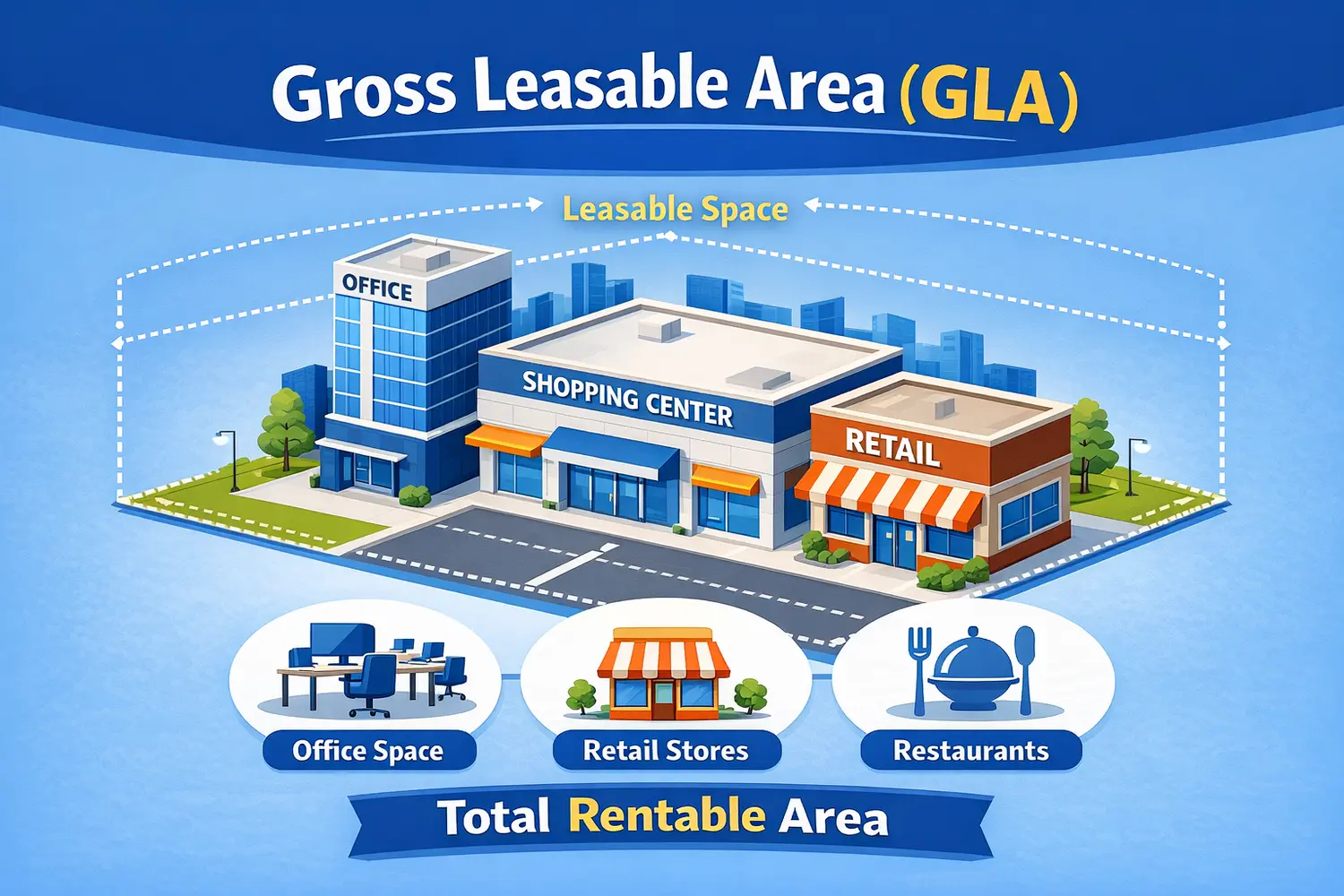
Gross leasable area (GLA) is a key metric in commercial real estate for measuring the total floor space available to lease. It excludes purely non-revenue areas and is used by developers, landlords, and investors to project rental income and value. In practice, GLA counts the actual leasable portions of a building (shop floors, offices, storage, etc.) while omitting spaces like hallways, elevators, and mechanical rooms. This industry-standard measurement is especially important in markets like Dubai’s booming retail sector, where malls advertise their GLA figures (for example, Dubai Mall’s GLA is approximately 350,000 m²) to showcase potential rent and foot traffic.
Gross Leasable Area (GLA) is the total floor area of a commercial property that can be leased to tenants. It essentially represents the sum of all leasable units and income-generating spaces in the building. GLA is used widely in commercial real estate companies developers use it to plan building sizes, landlords use it to set rents, and investors use it to estimate revenues. As CommLoan notes, GLA “is one of the most common and easiest ways to project the potential rents of a property,” since it focuses on space that can earn income. In fact, most commercial lease rates and valuation models are based on GLA (so it’s a deeply embedded industry standard). (Note: GLA is not typically used for residential homes; instead, a similar concept called "Gross Living Area" measures finished residential space.)
Real estate professionals and tenants alike track GLA carefully. For example, the Building Owners and Managers Association (BOMA) provides standardized guidelines for measuring GLA to ensure consistency. Under BOMA rules, one measures from the interior side of exterior walls and includes all space designated for tenant use. Any vertical walls that separate a tenant’s space from another are typically divided (half counted in each unit) so totals align. This standardized calculation is critical: it tells lenders, investors, and tenants exactly how much leasable area exists, regardless of the building’s layout or number of levels.
In the context of commercial and retail properties, GLA has a specific meaning: it is the aggregate of all tenant-occupied space designed for revenue generation. For example, in a shopping center, GLA equals the sum of every store’s floor area (sales floors, kiosks, showrooms) plus their back-of-house storage or office areas. CIP Texas explains that in retail properties, GLA typically “encompasses the store’s sales floor, stockrooms, and private offices”. In an office building, GLA includes all rentable office suites and any dedicated support spaces (like private conference rooms or file storage) within each suite. In industrial or warehouse facilities, GLA covers the leased manufacturing or storage zones, plus any loading docks or mezzanines that tenants occupy.
Crucially, GLA excludes shared common areas and building services. The usable area inside each tenant’s walls is counted; by contrast, corridors, lobbies, public restrooms, stairs, elevator shafts, and utility rooms are not part of GLA. (This differs from gross floor area, which includes literally all space under the roof.) In other words, GLA is what each tenant pays rent on. If a multi-tenant building has 10,000 ft² of total interior space but 1,000 ft² of that is corridors and maintenance rooms, the GLA might be 9,000 ft². The concept of usable area (often called Net Leasable Area or NLA) is related: NLA is just the tenant’s actual occupiable floor inside its walls. GLA typically ends up slightly larger than NLA, since GLA may include things like a portion of enclosing walls or a share of certain common corridors, depending on measurement rules.
In summary, Gross Leasable Area is the industry standard measure of revenue-generating space in a commercial property, whether it’s a retail center, an office complex, or a mixed-use development. By focusing on leasable square footage, GLA provides a common basis for comparing properties and calculating rents and values.
Calculating GLA involves measuring the building and then subtracting non-leaseable parts. The general steps are:
According to BOMA guidelines, any walls that separate tenant spaces from others are handled carefully: interior tenant walls are fully counted for that tenant, whereas walls between tenants are divided in half so that each side’s GLA sums correctly. The formula can thus be summarized as:
Gross Leasable Area (GLA) = Total Interior Area – Space Not Usable to Tenants.
In practice, this means you take the total square footage of the building’s floors, then subtract any area dedicated to common or structural uses. What remains is the GLA: the portion that will be rented out to tenants.
The core calculation is often expressed simply as:
GLA = Total Area Available for Lease – Non-Leasable Space
For example, if a single-story retail strip covers 10,000 ft² of floor area, but 500 ft² of that is public corridor and 200 ft² is a manager’s office, then the GLA would exclude those: GLA = 10,000 ft² – (500 + 200) = 9,300 ft².
In detailed surveys, professionals may measure each lease space individually and then sum them, applying the BOMA rules for walls. But conceptually, GLA just boils down to “space earning rent” vs. “space not rented.” As one industry source notes, GLA “focuses on the total usable floor space that generates rental income.” ”
GLA includes any space within a property that can be rented to tenants. Key examples are:
For instance, CIP Texas explains that in a shopping mall, GLA “encompasses the store’s sales floor, stockrooms, and private offices”. In an office building, GLA includes each suite’s interior space – the areas a tenant exclusively uses. The key is that every included area must be tied to tenant rent.
By contrast, common and service areas are excluded from GLA. These spaces are not leased out to any one tenant, so they do not count. Typical exclusions are:
Put simply, anything that isn’t rented doesn’t count. For example, CIP Texas explicitly lists “common hallways and lobbies, shared restrooms, stairwells, mechanical rooms, elevator shafts, [and] emergency exits” as spaces not included in GLA. Likewise, driveways and parking lots are omitted since they aren’t enclosed, leasable space.
It’s common for untrained estimates to mistakenly include these areas. For accuracy, one must carefully separate each part of the building. The excluded areas can be substantial — for instance, an anchor store might have large common lobby fronts that aren’t counted, or a mall might have dozens of interior corridors that never contribute to GLA.
GLA is crucial because it directly drives revenue and value in commercial real estate. Here’s why it matters:
In short, GLA ties directly to money. When you know the gross leasable area, you can compute potential rent, compare properties, and make informed decisions. As one source states, GLA is “an important factor when assessing the commercial value of a property because it indicates how much tenant rental income can be generated”. Without GLA, you wouldn’t have a consistent way to calculate rents or value among different buildings.
Consider a simple example of a small retail shopping center to see how GLA is calculated. Suppose the center has four leased units: three inline shops and one larger anchor store. Their individual spaces are:
Each “+” indicates a backroom/storage area. In total, the tenant spaces add up to:
Total shop space = (2000+200) + (1500+200) + (1000+200) + (5000+1000) = 11,100 ft²
Now, suppose there is also a common hallway of 500 ft² running through the center (used by all tenants and the public). That hallway is not leased, so it is excluded from GLA.
Therefore, the Gross Leasable Area is the sum of the leased spaces (11,100 ft²) and does not include the 500 ft² corridor. So, in this example:
GLA = 11,100 ft².
This means the landlord can market and lease a total of 11,100 ft² of rentable space. The 500 ft² hallway is part of the building’s gross area, but it’s not counted in GLA. If the average rent is $20/ft²/year, the potential annual income is 11,100 × $20 = $222,000.
This simple calculation highlights how GLA focuses only on revenue areas. By excluding non-leased space, it gives a clear measure of the building’s rentable footprint.
In the retail sector, GLA is especially visible and important. Large shopping malls and centers routinely publish their gross leasable area as a key statistic. For instance, Dubai Mall – one of the world’s largest malls – boasts about 350,000 m² of gross leasable area. Mall of the Emirates in Dubai has roughly 223,000 m² of GLA. These figures are critical: they tell retailers and investors how much retail space is available under one roof. A big GLA often correlates with a wide variety of shops and high foot traffic.
Retailers looking to open a store will consider a mall’s GLA when deciding on location. A large GLA usually means many anchor stores and high visitor counts, but also more competition. Brand managers use GLA (alongside demographics and traffic data) to evaluate site potential. For example, when choosing where to place a new flagship store, a retailer might favor a mall with ample GLA since it indicates a bustling shopping environment.
For shopping center developers and owners, maximizing GLA (while keeping customer flow manageable) is a key design goal. In mixed-use projects, retail components are planned with GLA in mind. Dubai’s rapid retail expansion highlights this: Dubai Holding’s “Dubai Retail” group now encompasses over 40 shopping and lifestyle destinations totaling more than 13 million sq ft of GLA. This vast GLA portfolio reflects the scale of the retail market in the UAE.
In smaller retail centers (like strip malls or community malls), GLA determines how many shops can be leased. For investors in retail property, comparing GLA across different centers helps gauge potential income. For example, a property listing might say “2,000 m² GLA strip mall in Jumeirah,” allowing a buyer to directly relate that to expected rent-roll.
Overall, GLA is the common language in retail real estate. It quantifies the leasable retail footprint that tenants and investors care about. When you see a mall described as having a certain GLA, you know exactly what that means: the sum of all its rentable shop spaces.
Measuring GLA can be tricky, and errors are common if one is not careful. Some pitfalls include:
By avoiding these mistakes, landlords and tenants ensure they have an accurate GLA number. Accurate GLA leads to fairer leases and more reliable investment analysis.
Q: Is Gross Leasable Area the same as Rentable Area?
A: Not exactly. Gross Leasable Area refers to the physical floor space a tenant can lease. Rentable Area (sometimes called Rentable Square Feet) typically includes the tenant’s GLA plus a pro-rata share of the building’s common areas (like lobbies or shared corridors). In other words, landlords often charge tenants rent on Rentable Area, which is usually slightly larger than GLA. For instance, if your store’s GLA is 2,000 ft², the rentable area might be 2,200 ft² once you add your share of common hallways.
Q: Does Gross Leasable Area include parking?
A: No. GLA covers indoor floor area that can be leased. It does not include parking lots, driveways, or garages. Those are separate from GLA because they are not part of the building’s leasable square footage. If a project includes a parking structure, that area is measured and valued separately (often using parking rates, not the price per sq. ft. used for GLA).
Q: Who calculates Gross Leasable Area?
A: GLA is usually calculated by professionals (architects, building managers, or appraisers) following industry standards. In commercial real estate, organizations like BOMA (Building Owners and Managers Association) set guidelines on how to measure GLA. Typically, the building owner or developer will obtain a GLA survey from a licensed measurer or use architectural plans to compute it accurately. Both landlords and tenants may verify the GLA through independent measurement before finalizing a lease.
Q: Is GLA used for residential properties?
A: Generally, no. The term GLA (Gross Leasable Area) is specific to commercial and retail properties. For homes and apartments, a similar concept is “Gross Living Area,” which only counts finished residential living space. In residential rentals Properties (like apartments), metrics such as the number of units or total apartment square footage are more commonly used. As one industry note points out, GLA is “much less often used when leasing multi-unit residential properties”. Instead, landlords in residential real estate focus on unit counts and sizes.
Gross Leasable Area is a foundational concept in commercial real estate. It provides a clear, quantifiable measure of how much revenue-producing space a property has. By focusing on the actual leasable footprint, GLA ensures landlords, tenants, and investors all work from the same page when it comes to rent, value, and design. Whether you’re a Dubai developer planning the next mall, an investor analyzing retail property, or a tenant negotiating a new lease, understanding GLA is essential. It affects lease rates, investment returns, and even how buildings are designed and marketed. In any case, accurately measured GLA allows for fair agreements and sound financial planning.
Latest Blogs
Sep 21, 2026

Sep 18, 2026

Sep 15, 2026

Sep 12, 2026

Sep 9, 2026